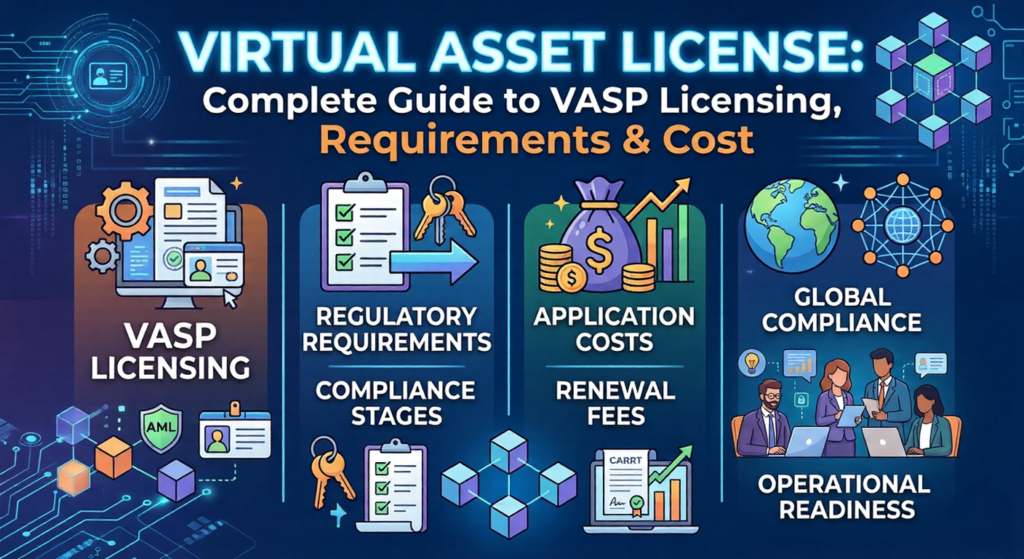
Entering the global digital finance market offers significant opportunities for fintech startups, crypto exchanges, and blockchain-based platforms—but it also brings strict regulatory obligations. One of the most important requirements is obtaining a virtual asset license, also known as a VASP license. If your business involves exchanging, transferring, or safeguarding digital assets such as cryptocurrencies, securing this license is not optional—it is a legal requirement in most jurisdictions.
This comprehensive guide explains everything you need to know about a virtual asset license, including key requirements, costs, the step-by-step process, and the best countries to get licensed, helping you launch and scale your crypto business with confidence, compliance, and long-term stability.
What is a Virtual Asset License?
A virtual asset license is a formal legal authorization issued by regulatory authorities to businesses that operate within the digital asset ecosystem. This includes companies dealing with cryptocurrencies, tokens, and blockchain-based financial services. In today’s regulated financial environment, obtaining a virtual asset license is essential for operating legally and building long-term trust.
This license is typically granted to businesses classified as Virtual Asset Service Providers (VASPs). These entities are directly involved in handling, transferring, or safeguarding digital assets on behalf of users.
Businesses that require a virtual asset license include:
- Cryptocurrency exchanges facilitating buying and selling of digital assets
- Platforms enabling the transfer of virtual currencies
- Custodial wallet providers holding user funds
- Crypto payment processors and intermediaries
- Brokerage and trading platforms dealing in virtual assets
The primary objective of a virtual asset license is to ensure transparency, accountability, and compliance with global financial regulations. Licensed businesses must adhere to strict frameworks related to anti-money laundering (AML), counter-terrorism financing (CTF), and customer protection.
Most jurisdictions align their regulations with global frameworks such as the guidelines issued by the
Financial Action Task Force.
Who Needs a Virtual Asset License?
Understanding whether your business requires a virtual asset license is a critical first step before entering the crypto or fintech industry. Regulatory authorities assess your actual activities—not just how your business is described—so clarity here is essential.
You need a virtual asset license if you:
- Operate a cryptocurrency exchange platform
- Offer custodial wallet or asset storage services
- Facilitate crypto payments, transfers, or settlements
- Provide brokerage, trading, or liquidity services
- Act as an intermediary in digital asset transactions
You may not need a virtual asset license if you:
- Only develop blockchain software or infrastructure
- Provide non-custodial wallets without control over user funds
- Offer purely decentralized solutions with no financial control
However, there’s a key reality:
If your platform interacts with, controls, or processes user funds at any point, regulators will most likely classify your business as a VASP—meaning a virtual asset license is required.
Virtual Asset License Requirements
Obtaining a virtual asset license is not just about paperwork—it requires building a fully compliant, secure, and transparent business structure. Regulatory authorities carefully evaluate both financial integrity and operational readiness before granting approval.
Core requirements for a virtual asset license include:
Business Registration
- Incorporation of a legal entity (such as an LLC or corporation)
- Clear ownership structure and corporate governance framework
AML and KYC Compliance
- Implementation of Anti-Money Laundering (AML) policies
- Strong Know Your Customer (KYC) procedures
- Identity verification and customer due diligence systems
Risk Management Framework
- Identification of financial, operational, and compliance risks
- Internal controls to monitor and mitigate these risks
- Ongoing transaction monitoring systems
Compliance Officer
- Appointment of a qualified compliance professional
- Responsibility for regulatory reporting and adherence
Technology Infrastructure
- Secure and scalable transaction systems
- Data protection and cybersecurity measures
- Fraud detection and prevention tools
A well-structured compliance framework is not just a requirement—it’s the backbone of a successful and sustainable crypto business. Without it, obtaining or maintaining a virtual asset license becomes extremely difficult.
For professional assistance, explore our
virtual asset licensing service.
Step-by-Step Process to Get a Virtual Asset License
Obtaining a virtual asset license is a structured and detailed process. Each step is critical to ensure compliance with regulatory authorities, build credibility, and secure your ability to operate legally in the crypto and digital asset space. Here’s a comprehensive, step-by-step guide to help you navigate the process effectively.
Step 1: Define Your Business Model
Before starting any licensing process, it is crucial to clearly define your business model. This includes understanding exactly what services your company will offer, how it will generate revenue, and the scope of your operations. Regulatory authorities assess your business model carefully to classify your entity as a Virtual Asset Service Provider (VASP) and determine the exact licensing requirements.
Key points to consider:
- Identify the types of virtual assets you will handle (cryptocurrencies, tokens, stablecoins, etc.)
- Define whether your platform will provide exchange, wallet, custody, or payment services
- Determine your target markets and potential customer base
- Establish a revenue model and operational strategy
A clearly defined business model not only streamlines the licensing process but also demonstrates credibility to regulators.
Step 2: Choose the Right Jurisdiction
Selecting the right jurisdiction is one of the most strategic steps in obtaining a virtual asset license. Regulatory requirements, costs, approval timelines, and the ease of doing business vary widely from country to country.
When evaluating jurisdictions, consider:
- Regulatory clarity and transparency
- Licensing costs and application fees
- Speed of approval and regulatory responsiveness
- Market access and credibility in the global crypto ecosystem
- Alignment with FATF and international standards
Popular jurisdictions for virtual asset licensing include the UAE (Dubai – VARA), Singapore, Estonia, Lithuania, and certain EU countries under MiCA regulations. Each offers unique advantages depending on your business goals.
Step 3: Register Your Business Entity
A legally recognized business entity is mandatory before applying for a virtual asset license. Authorities will not process applications from unregistered entities.
Requirements typically include:
- Formation of an LLC, corporation, or equivalent entity
- Obtaining a local business registration number
- Defining ownership and management structure
- Opening a corporate bank account
Proper legal structuring demonstrates operational seriousness and is a prerequisite for compliance evaluation.
Step 4: Develop a Robust Compliance Framework
Regulators prioritize compliance readiness over all other factors. Developing a strong compliance framework is essential for license approval.
AML Policies
Anti-Money Laundering (AML) policies are at the core of regulatory requirements. Your AML framework should:
- Detect and prevent money laundering and terrorist financing
- Define risk-based monitoring protocols
- Include reporting obligations for suspicious transactions
KYC Procedures
Know Your Customer (KYC) procedures are mandatory for verifying client identities. This includes:
- Customer onboarding checks
- Verification of identification documents
- Monitoring high-risk clients
Transaction Monitoring
A reliable transaction monitoring system is critical to track and flag unusual activity. Features should include:
- Real-time alerts for suspicious transactions
- Automated reporting mechanisms
- Integration with AML and KYC frameworks
A well-structured compliance framework signals professionalism and reduces the risk of application rejection.
Step 5: Prepare Required Documentation
Regulatory authorities require extensive documentation to process your virtual asset license application. Missing or incomplete documents are a common cause of delays.
Key documents typically include:
- Comprehensive business plan outlining services and revenue model
- Financial projections demonstrating liquidity and solvency
- Compliance manuals detailing AML, KYC, and risk management procedures
- Ownership and governance documents, including directors and shareholders
- Technology and operational structure details
Careful preparation of documentation increases approval chances and shortens the review timeline.
Step 6: Submit Your Application
Once your documentation is complete, submit your application to the relevant regulatory authority in your chosen jurisdiction. Ensure all forms are filled accurately and all supporting documents are included. Many jurisdictions now provide online submission portals for convenience.
Tips for submission:
- Double-check that all documents meet local formatting and certification requirements
- Ensure compliance frameworks are clearly documented
- Attach all legal entity and ownership proofs
Accurate and complete applications reduce back-and-forth requests from regulators.
Step 7: Regulatory Review and Clarifications
After submission, regulatory authorities will conduct a thorough review of your application. This step is critical and can take several weeks to months, depending on jurisdiction and complexity. During this period, expect:
- Requests for additional clarifications on business operations
- Questions about compliance frameworks and risk management
- Possible on-site audits or interviews with key personnel
Prompt and precise responses to regulator queries can significantly accelerate the approval process.
Step 8: Approval and Licensing
Once your application passes the regulatory review, you will receive your virtual asset license, officially authorizing your business to operate as a VASP.
Key benefits of approval:
- Legal authorization to provide crypto and digital asset services
- Enhanced trust from customers, partners, and investors
- Access to banking and payment infrastructure
- Opportunity to expand operations across multiple jurisdictions
It’s important to note that licensing is just the beginning—ongoing compliance and reporting are mandatory to maintain your license.
Step 9: Ongoing Compliance and Renewal
After obtaining your virtual asset license, maintaining compliance is critical. Regulatory authorities require regular reporting, audits, and updates to operational procedures.
Ongoing obligations include:
- Annual or periodic license renewals
- Continuous AML/KYC monitoring
- Regulatory reporting and audits
- Risk assessments and compliance reviews
Failure to maintain these obligations can result in penalties or license revocation, which can significantly damage business reputation and operations.
Cost of a Virtual Asset License
The cost of obtaining a virtual asset license can vary widely depending on the jurisdiction, complexity of operations, and scale of your business. While the investment may seem significant, it is essential for legal compliance and long-term credibility in the crypto and digital asset ecosystem.
Estimated Cost Breakdown:
- Legal and consulting fees: $20,000 – $100,000+
- Government application and licensing fees: $5,000 – $50,000 (varies by country)
- Compliance setup: $10,000 – $80,000 (AML, KYC, risk management frameworks)
- Operational costs: Variable (technology, security, and staffing)
Total Estimated Cost: $30,000 – $150,000+
Choosing the right jurisdiction can dramatically affect both cost and approval speed, making strategic planning critical before starting the application process. For multi-jurisdiction operations, businesses should budget carefully, as costs can compound quickly.
Best Countries for Virtual Asset License
Selecting the ideal jurisdiction is one of the most important strategic decisions for any business seeking a virtual asset license. Different countries offer unique regulatory frameworks, approval timelines, and operational advantages.
Top Jurisdictions:
1. UAE (Dubai – VARA)
- Crypto-friendly regulations and government support
- Clear licensing process for VASPs
- Access to a fast-growing regional market
2. European Union (MiCA Regulations)
- Standardized framework across EU member states
- Easier access to European markets
- Credible regulatory environment for institutional investors
3. Singapore
- High international credibility and reputation
- Strict but transparent licensing requirements
- Ideal for global crypto exchanges and fintech startups
4. Hong Kong
- Strong financial ecosystem with growing crypto adoption
- Strategic gateway to Asia-Pacific markets
- Clear guidelines for virtual asset service providers
5. Estonia / Lithuania
- Startup-friendly regulatory environment
- Faster licensing process compared to larger jurisdictions
- Lower operational and compliance costs
Selecting the right country should align with your business model, target customers, and long-term expansion strategy.
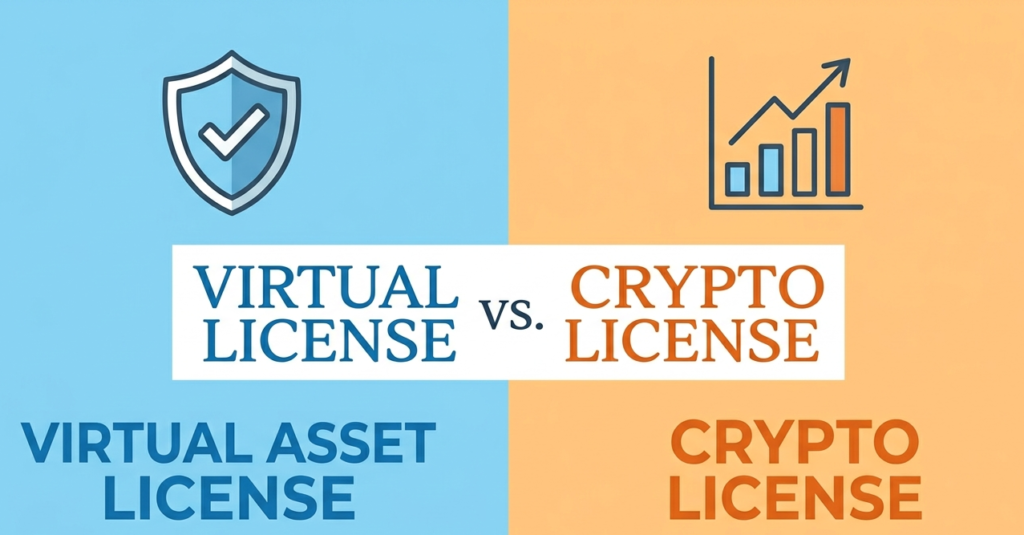
Virtual Asset License vs Crypto License
While often used interchangeably, “virtual asset license” and “crypto license” have subtle but important differences:
| Feature | Virtual Asset License | Crypto License |
|---|---|---|
| Scope | Broad, covers all VASPs | General term, less formal |
| Regulation | Officially recognized by regulators | Informal usage in marketing |
| Coverage | Exchanges, wallets, transfers, custodial services | Varies by platform and jurisdiction |
Key takeaway: A virtual asset license is the formal regulatory requirement for operating legally in most jurisdictions. Using the correct terminology ensures credibility with authorities, partners, and investors.
Common Mistakes in Virtual Asset Licensing
Avoiding pitfalls increases the likelihood of successful license approval. Common mistakes include:
1. Underestimating Compliance Requirements
Regulators scrutinize AML, KYC, and risk management systems. Weak frameworks are one of the main reasons applications are rejected.
2. Choosing the Wrong Jurisdiction
Not every jurisdiction fits every business model. Consider regulatory clarity, costs, and market potential before applying.
3. Incomplete or Inaccurate Documentation
Applications with missing or inconsistent information often face delays. Every detail matters—from ownership structure to financial projections.
4. Ignoring Expert Guidance
Licensing for virtual assets is complex. Consulting experienced legal and compliance professionals significantly increases your chances of approval.Licensing is complex and requires professional legal and compliance expertise. Consider our specialized virtual asset license services for guidance.
5. Overlooking Operational Readiness
Technology infrastructure, security systems, and staffing must meet regulatory standards. Demonstrating operational readiness is critical for regulators.
Why a Virtual Asset License is Important
A virtual asset license is more than a legal formality—it is a strategic advantage for your business.
Key Benefits:
- Legal Authorization: Operate as a compliant VASP without risk of fines or legal action.
- Increased Customer Trust: Licensed businesses inspire confidence among clients and partners.
- Better Banking Relationships: Banks and payment providers are more willing to work with licensed entities.
- Access to Global Markets: Licensing enables expansion into international markets with regulatory recognition.
- Higher Investor Confidence: Investors prefer businesses that are fully compliant and risk-managed.
Operating without proper licensing exposes your business to regulatory penalties, restrictions, or shutdown, making the investment in compliance essential for long-term success.
For professional guidance, explore our full fintech compliance solutions to streamline licensing and maintain ongoing regulatory compliance.
Expert Support for Virtual Asset License
Navigating the virtual asset license process can be complex, time-consuming, and highly regulated. It requires detailed planning, robust compliance frameworks, and a thorough understanding of both local and international regulations. Working with experienced professionals, like 7baas, can significantly increase your chances of approval while reducing time, costs, and operational headaches.
How 7baas helps:
- End-to-end guidance: From choosing the right jurisdiction to submitting applications, 7baas supports every stage of the licensing process.
- Compliance frameworks: We help you design and implement AML, KYC, and risk management systems that meet regulatory standards.
- Documentation support: Our experts prepare complete and accurate business plans, compliance manuals, and ownership documents.
- Operational readiness: 7baas ensures your technology, security, and staffing are aligned with regulatory requirements.
- Ongoing support: After licensing, we help maintain compliance, manage renewals, and adapt to regulatory updates.
For businesses seeking hands-on assistance, explore our virtual asset licensing services. You can also access our full fintech compliance solutions to ensure your operations remain fully compliant and scalable.
Final Thoughts on Virtual Asset License
Obtaining a virtual asset license is a crucial step for any business operating in the digital asset space. While the process requires planning, financial investment, and regulatory compliance, it provides a strong foundation for long-term growth, credibility, and market access.
How 7baas adds value:
- We help businesses build trust with customers, investors, and financial institutions through full regulatory compliance.
- Our strategic guidance enables clients to scale globally without running afoul of jurisdictional requirements.
- 7baas ensures your business can attract investors by demonstrating operational readiness and legal security.
- With our ongoing support, companies can operate without legal risk, even in highly regulated markets.
In an increasingly regulated crypto landscape, securing a virtual asset license through expert support is not just about compliance—it is about building a sustainable, future-ready business.
Frequently Asked Questions (FAQs)
How long does it take to get a virtual asset license?
The timeline typically ranges from 3 to 12 months, depending on jurisdiction, application quality, and business complexity. 7baas helps streamline the process to minimize delays.
Do all crypto businesses need a virtual asset license?
Most businesses that handle, transfer, or store digital assets require a virtual asset license. 7baas evaluates your operations to confirm whether licensing is necessary.
What is a VASP license?
A VASP license (Virtual Asset Service Provider license) is another term for a virtual asset license. It is required for businesses offering services such as exchanges, wallets, custody, or token transfers. 7baas guides crypto platforms through the VASP licensing process from start to finish.
Can I operate without a virtual asset license?
No. Operating without proper licensing can result in penalties, fines, or business shutdowns. 7baas ensures that your business is fully compliant to mitigate these risks.