The United States remains one of the largest and most regulated financial markets in the world. Fintech companies offering payment services, remittances, digital wallets, or crypto-related transactions must comply with strict federal and state regulations.
If your company plans to transmit money within or from the United States, understanding the US money transmitter license framework is essential.
Unlike many jurisdictions with a single national license, the US operates under a dual regulatory system. Companies must register federally and, in most cases, obtain licenses at the state level. This makes compliance more complex — but also critical for long-term scalability.
This guide explains:
- What a money transmitter license is
- Who needs one in the US
- Federal vs state regulatory requirements
- Step-by-step application process
- Compliance obligations
- Estimated costs and timelines
- Common challenges and mistakes
For structured regulatory advisory across jurisdictions, you can review fintech licensing services at 7baas.
What Is a US Money Transmitter License?
A money transmitter license (MTL) allows a company to legally transmit funds on behalf of customers.
Money transmission generally includes:
- Receiving money for transfer
- Sending money domestically or internationally
- Processing payments
- Issuing stored value
- Operating digital wallets
- Facilitating remittances
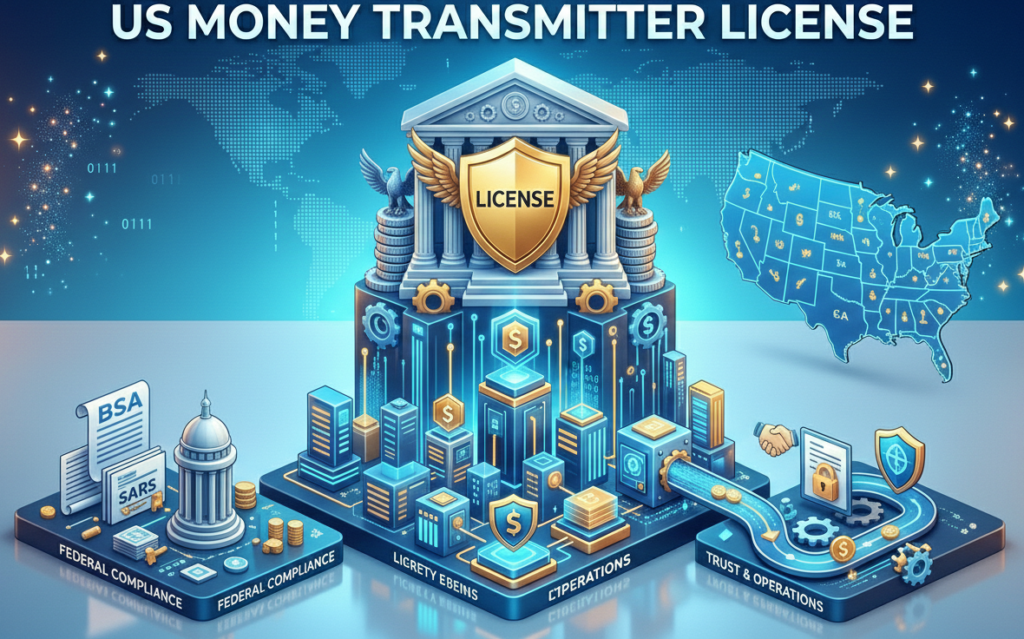
In the United States, regulation occurs at two levels:
- Federal level (FinCEN registration)
- State level licensing (individual state regulators)
Both components are typically required.
Who Needs a Money Transmitter License in the US?
Determining whether your business requires a license depends on your activities.
Businesses That Typically Require Licensing
- Payment processors
- Remittance companies
- Digital wallet providers
- Peer-to-peer payment platforms
- Fintech apps handling customer funds
- Certain crypto exchanges and custodians
If your company receives funds from one party and transmits them to another, licensing requirements likely apply.
However, exemptions may exist for:
- Banks
- Authorized agents of licensed entities
- Certain technology-only service providers
A careful regulatory assessment is necessary before launching operations.
Federal Requirements: FinCEN Registration
Before applying for state licenses, companies must register with the Financial Crimes Enforcement Network (FinCEN) as a Money Services Business (MSB).
FinCEN operates under the US Department of the Treasur.
Key Federal Requirements
- MSB registration
- AML program implementation
- Designation of compliance officer
- Suspicious Activity Report (SAR) filing
- Currency Transaction Report (CTR) filing
- Ongoing monitoring and recordkeeping
FinCEN registration does not replace state licensing. It is an additional federal obligation.
State Money Transmitter License Requirements
Unlike the federal system, each US state regulates money transmission independently.
This means that if your business operates nationwide, you may need licenses in multiple states.
Core State-Level Requirements
Although requirements vary, most states require:
- Minimum net worth thresholds
- Surety bond
- Background checks for control persons
- Business plan submission
- Compliance policies
- Financial statements
- Application fees
Applications are commonly submitted through the Nationwide Multistate Licensing System (NMLS).
Step-by-Step US Money Transmitter License Application Process
Understanding the process helps structure preparation efficiently.
Step 1: Conduct Regulatory Assessment
Before applying, determine:
- Which states you plan to operate in
- Whether your business model qualifies as money transmission
- Whether exemptions apply
- Whether crypto activities trigger additional scrutiny
Proper legal analysis prevents costly restructuring later.
Step 2: Register with FinCEN as an MSB
Federal registration must occur before or alongside state applications.
This includes:
- Filing MSB registration form
- Implementing AML program
- Appointing compliance officer
- Establishing reporting procedures
Federal compliance forms the foundation of your licensing structure.
Step 3: Prepare State-Level Documentation
Each state requires detailed submissions.
Common documentation includes:
- Corporate formation documents
- Ownership disclosures
- Financial statements
- Compliance manuals
- Risk assessment framework
- Business plan
- Surety bond
Incomplete submissions significantly delay approval.
Step 4: Secure Surety Bonds
Most states require a surety bond to protect consumers.
Bond amounts vary depending on:
- Transaction volume
- State requirements
- Business model
Surety bonds often range from tens of thousands to several hundred thousand dollars.
Step 5: Submit Applications Through NMLS
Many states use the Nationwide Multistate Licensing System.
Applications include:
- Individual MU forms
- Company MU forms
- Financial disclosures
- Compliance documentation
Background checks and fingerprinting are typically required.
Step 6: Regulatory Review and Follow-Up
State regulators may:
- Request additional information
- Conduct interviews
- Require financial clarification
- Review AML controls
Approval timelines vary significantly between states.
Estimated Timeline for US Money Transmitter Licensing
Approval depends on:
- Number of states
- Application completeness
- Business complexity
- Regulatory backlog
Below is a general estimate:
| Scope | Estimated Timeline |
|---|---|
| Single-state license | 3–6 months |
| Multi-state expansion | 6–12 months |
| Nationwide licensing (multiple states) | 12–24 months |
Timelines increase with complexity and geographic coverage.
Cost of a US Money Transmitter License
Costs vary widely depending on scope.
Typical Cost Components
- State application fees
- Surety bond premiums
- Legal and advisory fees
- Compliance program development
- Financial audits
- Ongoing reporting costs
Multi-state licensing can require substantial investment due to bond requirements and regulatory fees.
Compliance Obligations After Approval
Obtaining approval is only the beginning.
License holders must maintain:
- Ongoing AML monitoring
- Periodic state reporting
- Financial statement submissions
- Surety bond maintenance
- Federal SAR and CTR filings
Non-compliance can result in:
- Fines
- License suspension
- Revocation
- Enforcement actions
Maintaining strong compliance systems is essential for sustainable operations.
Common Challenges in US Money Transmitter Licensing
The US system is considered one of the most complex globally.
Major Challenges Include:
- State-by-state variation
- High bonding requirements
- Capital thresholds
- Lengthy approval timelines
- Regulatory scrutiny of crypto activities
Without structured preparation, companies may face extended delays or unexpected regulatory hurdles.
US Money Transmitter License vs EMI License
Unlike an EMI license in the UK or EU, the US system does not offer passporting rights.
Key differences include:
- Separate licensing in each state
- Federal MSB registration requirement
- Surety bond obligations
- Different compliance reporting frameworks
Companies expanding internationally often require both US state licensing and separate approvals in other jurisdictions.
Why Structured Regulatory Planning Matters
Because US money transmission laws are complex and fragmented, strategic preparation significantly improves efficiency.
Professional advisory support can help with:
- State-by-state licensing strategy
- Documentation preparation
- Compliance framework design
- Surety bond structuring
- Ongoing regulatory management
For fintech companies building regulated infrastructure across multiple markets, structured licensing guidance reduces risk and improves scalability.
You can explore global fintech licensing advisory services at 7baas.
Conclusion
The US money transmitter license framework is one of the most comprehensive regulatory systems in the world. While the process is complex, it provides access to one of the largest and most valuable financial markets globally.
Success requires:
- Careful regulatory assessment
- Strong AML infrastructure
- Multi-state licensing strategy
- Ongoing compliance oversight
Companies that approach US licensing methodically position themselves for sustainable growth in the competitive US fintech landscape. With structured preparation and expert regulatory guidance, the process becomes more predictable and efficient.
For fintech businesses seeking strategic licensing support, 7baas provides structured advisory solutions to help navigate federal registration, state approvals, and long-term compliance planning with clarity and confidence.
Frequently Asked Questions About US Money Transmitter License
Do I need a license in every state?
If operating nationwide, you typically must obtain authorization in each applicable state.
Is FinCEN registration enough?
No. FinCEN registration is federal compliance but does not replace state licensing.
How long does it take to obtain nationwide approval?
Nationwide coverage can take 12 to 24 months depending on complexity.
Do crypto companies need a money transmitter license?
In many cases, yes. Crypto exchanges and custodial services often fall within money transmission laws.