
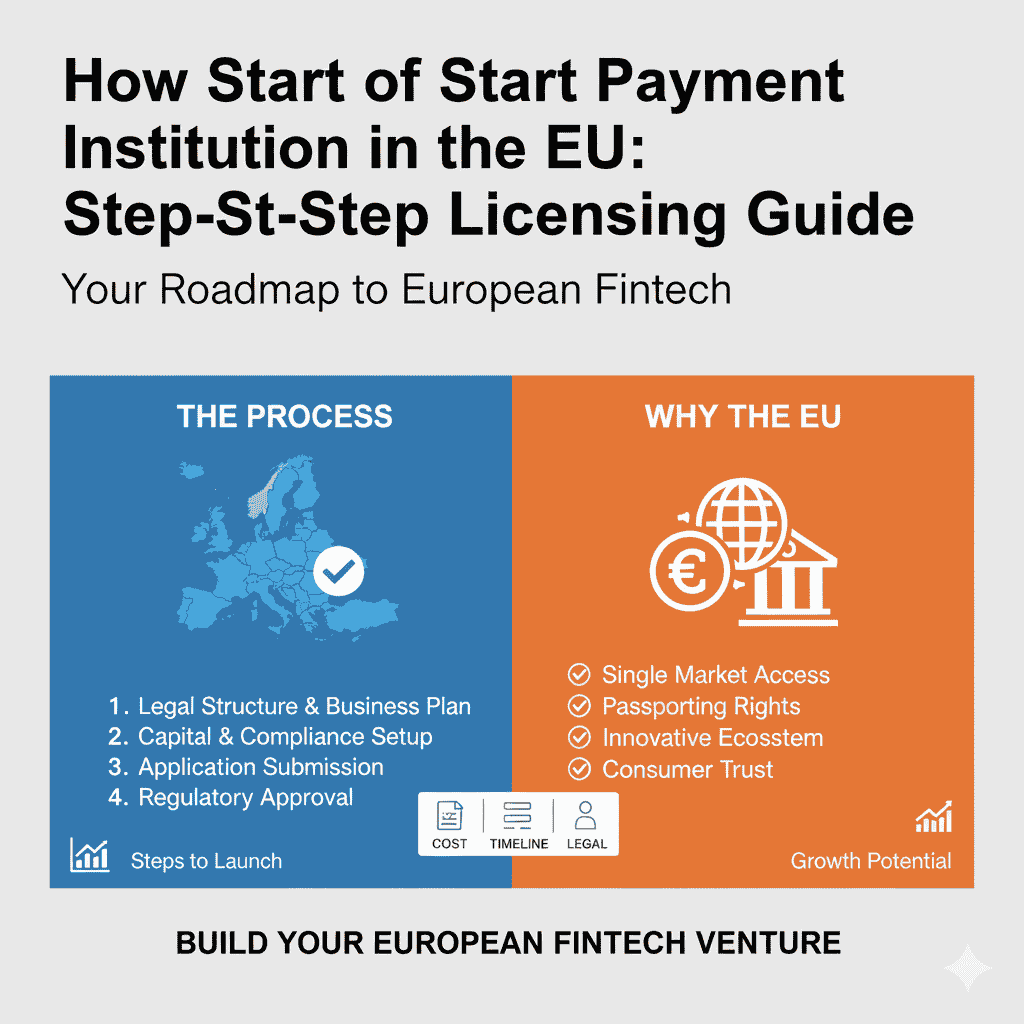
Launching a Payment Institution in the EU requires navigating the bloc’s financial regulations under PSD2. This guide explains what a Payment Institution license is, why it matters for fintech founders, and the steps to obtain it. It covers key requirements (capital, business plan, AML/KYC), highlights popular jurisdictions (Lithuania, Ireland, France), and even compares Payment Institution (PI) vs Electronic Money Institution (EMI) licensing. 7BaaS acts as a consulting partner to guide fintech startups through the process, ensuring compliance with EU standards.
Understanding EU Payment Institution Licensing
An EU Payment Institution license is an official authorization under the EU’s revised Payment Services Directive (PSD2) that allows a company to offer regulated payment services. In essence, a licensed Payment Institution can legally process payments, money transfers, account transactions and related services for clients. PSD2 (Directive 2015/2366) mandates that most payment service providers be authorized by national regulators to operate. A licensed Payment Institution can typically provide:
- Cash deposit and withdrawal services: Accepting money into customer accounts and disbursing cash.
- Payment transactions: Executing transfers, direct debits, standing orders, and card payments between accounts.
- Payment instruments and acquiring: Issuing payment instruments (e.g. cards) or acquiring merchant transactions.
- Remittance, PIS, and AIS: Operating money remittance, Payment Initiation Services (PIS), and Account Information Services (AIS) under PSD2.
Importantly, once authorized in one EU/EEA country, a Payment Institution gains passporting rights – it can extend services across the Single Market without separate local licenses. This pan-European access is a key benefit of EU licensing.
Regulatory basis: PSD2 requires national regulators to grant PI licenses. In practice, each country’s financial authority (e.g. Bank of Lithuania, Central Bank of Ireland, ACPR in France) sets the exact licensing procedures.
Benefits of a Payment Institution License
Obtaining a Payment Institution license brings several advantages for a fintech firm:
- Legal Compliance & Credibility: Operating under PSD2 law ensures full regulatory compliance, boosting trust with customers and banks. A licensed PI is a recognized, regulated entity, which makes clients and partners feel secure.
- Access to Banking Networks: Licensees can obtain European IBANs, join SEPA payment schemes, and integrate with real-time payment systems. For example, an Irish PI license lets a firm issue Euro accounts and participate in SEPA transactions across Europe.
- EU Market Reach: Thanks to passporting, a licensed PI can serve customers in any EU/EEA state under the same authorization. This enables scalable growth across borders.
- Competitive Edge: As Crassula notes, licensed firms often stand out in the market. Compliance and licensing serve as a “seal of approval,” giving companies a reputational advantage and easier access to banking services.
These benefits show why many fintech startups view EU PI licensing as a key step for growth. For more on license types, see 7BaaS’s Payment Institution vs EMI comparison.
Key EU Jurisdictions for Licensing
Different EU countries have varying processes and requirements for PI licenses. Some popular jurisdictions include:
- Lithuania: The Bank of Lithuania is known for fintech-friendly policies. It enforces the PSD2 rules, requiring initial capital of €20,000 for money remittance-only services, €50,000 for payment initiation, or €125,000 for full payment services. The BoL strongly encourages early engagement with applicants and typically reviews complete applications within about 3 months. License fees are modest (e.g. €898 in Lithuania) and many non-EU founders use its e-residency scheme.
- Ireland: The Central Bank of Ireland (CBI) also follows PSD2 rules. It requires a minimum €20,000 capital for a standard PI license. An Irish license grants full EEA passport rights. Ireland is attractive for its robust support for fintech and low corporation tax. As Buckingham notes, CBI applicants must safeguard client funds (via segregated accounts or insurance) and demonstrate qualified management.
- France: In France, the Autorité de Contrôle Prudentiel et de Résolution (ACPR) issues PI licenses under the French Monetary and Financial Code. The ACPR expects a thorough 3‑year business plan, clear internal controls and AML procedures, and proof of meeting prudential capital ratios. Depending on services, a PI might need €125,000 or more capital. Like Lithuania, France offers a “restricted” (small-volume) PI license (for <€3M/month) with lower capital, but no EU passport. ACPR encourages a pre-application meeting and aims to decide on complete applications within about 3 months.
Each jurisdiction has nuances. For example, Lithuania is often faster, while Ireland’s license is well-respected. A consulting partner (like 7BaaS) can advise which country fits a startup’s business plan.
Payment Institution vs Electronic Money Institution
Under EU law, Payment Institution (PI) and Electronic Money Institution (EMI) licenses have distinct scopes. A PI license (PSD2) covers payment services only. An EMI license (per the EU’s Electronic Money Directive, 2009/110/EC) additionally allows a firm to issue electronic money (e-money) and operate e-wallets. In other words, EMIs can create digital cash (prepaid balances), whereas PIs cannot.
Key differences include:
- Service Scope: Both can provide payment services (e.g. transfers, direct debits). Only EMIs can issue e-money or accounts with stored value.
- Capital Requirements: EMI licenses require much higher capital. Typically, an EMI must maintain at least €350,000 initial capital, whereas a PI’s capital depends on services (as low as €20k for money remittance only).
- Regulation: EMIs follow the EMD2 rules (plus PSD2 for payments); PIs follow PSD2 only. Each has its own safeguarding rules (e.g. EMIs must cover client funds with deposits or insurance).
- Passporting: Both license types can passport services EU-wide once granted in one member state.
Steps to Obtain a Payment Institution License
Obtaining an EU PI license is a multi-step process. Below is a general roadmap; specific steps vary by country:
- Select the jurisdiction. Decide which EU/EEA country’s regulator will authorize you. Consider where your target customers are and local licensing speed. (For example, fintechs often pick Lithuania or Ireland for their processes.)
- Prepare documentation and business plan. Compile a detailed 3-year business plan showing your model, markets, and financial projections. Establish corporate structures, risk management, AML/KYC policies, IT security, and governance procedures. Demonstrate qualified management and clear organizational charts.
- Meet capital and compliance requirements. Ensure you have the minimum capital on hand (e.g. €125k in many cases, or €20–50k for limited services). Also arrange safeguards for client funds (segregated accounts or insurance). Document financial statements and funding sources.
- Submit the application. File your license application form along with all required attachments (business plan, governance documents, shareholder info, compliance manuals, etc.) and pay the licensing fee. Some regulators require a pre-application meeting to review your proposal.
- Engage with the regulator. After submission, the authority reviews your file. Expect follow-up questions and requests for clarifications. Regulators may conduct interviews or on-site assessments. Respond promptly and provide any supplementary information. This phase is critical for a smooth outcome.
- Receive approval. If the regulator is satisfied, it will grant the Payment Institution license. In many EU countries, a complete application is decided within ~3 months. Upon approval, you can begin offering licensed payment services (subject to ongoing reporting).
Tip: Incomplete applications can significantly delay licensing (often extending review to 6–12 months). Engaging experts or consultants (like 7BaaS) early can improve application quality and speed.
Common Challenges and Solutions
Applying for an EU Payment Institution license can be complex. Common hurdles include:
- Stringent Capital and Compliance: Regulators set firm capital floors (often €125k or more) and require robust AML/KYC frameworks. Securing these can be time-consuming.
- Complex Documentation: The application package is extensive (hundreds of pages). Missing documents or weak details often trigger regulator queries. This paperwork burden is a frequent delay.
- Varying National Rules: Each country’s supervisor may have unique interpretations of PSD2. Differences in form requirements or local law (e.g. language, office requirements) can complicate multi-jurisdiction plans.
- Time and Resource Intensive: Preparing for licensure diverts resources from business development. The process can take months, during which market conditions may change.
Many of these challenges can be mitigated by early planning and expert help. For example, preparatory meetings with the regulator (encouraged in France and Lithuania) clarify requirements upfront. Working with a consultancy like 7BaaS can ease the burden: experts guide documentation, ensure regulatory compliance, and liaise with authorities on the applicant’s behalf.
Conclusion
In summary, starting a Payment Institution in the EU involves careful preparation around regulatory compliance under PSD2. Fintech founders must compile a solid business plan, meet capital and AML requirements, and navigate the national licensing process. Key EU jurisdictions – such as Lithuania, Ireland, and France – offer established pathways with their own timelines and criteria. Compared to EMI licensing, a PI license focuses on payment services and often has lower capital thresholds.
Obtaining an EU Payment Institution license ultimately grants access to Europe’s vast payments market and boosts credibility. Companies are advised to plan thoroughly and consider professional assistance. 7BaaS specializes in fintech licensing consultancy and can help streamline your Payment Institution application. Contact 7BaaS today to discuss how to launch your EU payments business with confidence.