
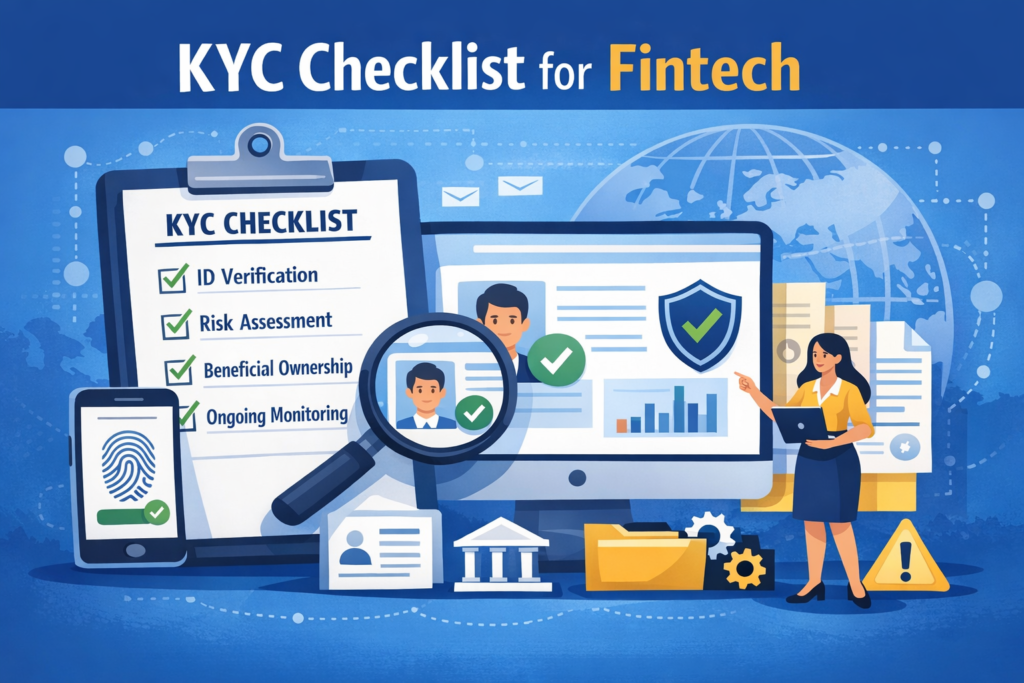
Financial service providers operate in increasingly regulated environments where customer verification is critical for preventing fraud and financial crime. Implementing an effective KYC checklist fintech companies can rely on ensures organizations identify customers accurately, assess risk exposure, and meet compliance expectations.
This guide outlines a practical KYC checklist fintech organizations can follow to strengthen onboarding, maintain transparency, and align with global regulatory standards.
Businesses seeking compliance advisory support can explore
https://7baas.com/services/
Why KYC Matters in Fintech
Customer verification protects organizations from identity fraud and financial misconduct. Without proper KYC frameworks, companies may face:
- Regulatory penalties
- Reputational damage
- Increased fraud risk
- Operational disruptions
A structured KYC checklist fintech teams implement improves onboarding reliability and supports regulatory compliance.
Background on KYC fundamentals:
https://www.investopedia.com/terms/k/knowyourcustomer.asp
Core KYC Checklist Fintech Organizations Should Implement
Identity Verification
A central component of any KYC checklist fintech companies deploy is validating customer identity.
Steps include:
- Government ID verification
- Biometric checks
- Address confirmation
- Document authentication
Digital onboarding tools improve speed and accuracy.
Learn about industry experience supporting compliance frameworks:
https://7baas.com/services/
Customer Risk Profiling
Risk classification ensures monitoring intensity matches exposure levels.
Evaluate:
- Geography
- Transaction behaviour
- Customer type
- Industry exposure
Risk-based approaches enhance operational efficiency.
Beneficial Ownership Identification
Organizations must verify ultimate ownership of accounts or entities.
Actions include:
- Ownership documentation review
- Verification checks
- Control structure analysis
Transparency helps reduce misuse risks.
Ongoing Monitoring
KYC is not a one-time process. Continuous monitoring detects suspicious changes.
Include:
- Behaviour tracking
- Transaction review
- Periodic verification updates
Monitoring strengthens overall compliance integrity.
Recordkeeping
Proper documentation ensures audit readiness.
Maintain:
- Identity records
- Verification logs
- Risk classification documentation
Retention policies must align with regulatory expectations.
Staff Training
Employees must understand verification procedures.
Training should:
- Explain onboarding protocols
- Highlight fraud indicators
- Update teams on regulatory changes
Knowledgeable staff improve compliance outcomes.
Independent Reviews
External assessments help ensure effectiveness.
Benefits:
- Identifying gaps
- Strengthening processes
- Preparing for regulatory review
Consultation support available here:
https://7baas.com/contact-us/
Strategic Value of Strong KYC Programs
A reliable KYC checklist fintech companies maintain supports:
- Faster approvals
- Customer trust
- Reduced fraud exposure
- Improved investor confidence
Industry insights and regulatory trends:
https://7baas.com/insights/
Future Trends in Digital KYC
Emerging developments include:
- AI identity verification
- Blockchain-based identity records
- Remote onboarding expansion
- Real-time risk analytics
Organizations adopting advanced verification tools remain competitive as digital finance evolves.
FAQs
What is a KYC checklist fintech businesses use?
A framework guiding customer verification and risk assessment processes.
Is KYC mandatory?
Yes — regulated financial service providers must verify customer identities.
How often should verification occur?
Regular updates depending on risk classification and regulatory requirements.
Does KYC improve customer trust?
Yes — transparent onboarding strengthens credibility.
Can consultants assist with KYC design?
Yes — experts help build scalable verification frameworks.
Conclusion
Implementing a structured KYC checklist fintech organizations rely on ensures customer transparency, risk management, and regulatory alignment. By integrating identity verification, monitoring, and governance controls, fintech companies enhance operational integrity while supporting sustainable growth.
Working with experienced advisory partners like 7BaaS further strengthens compliance readiness and market expansion potential.