
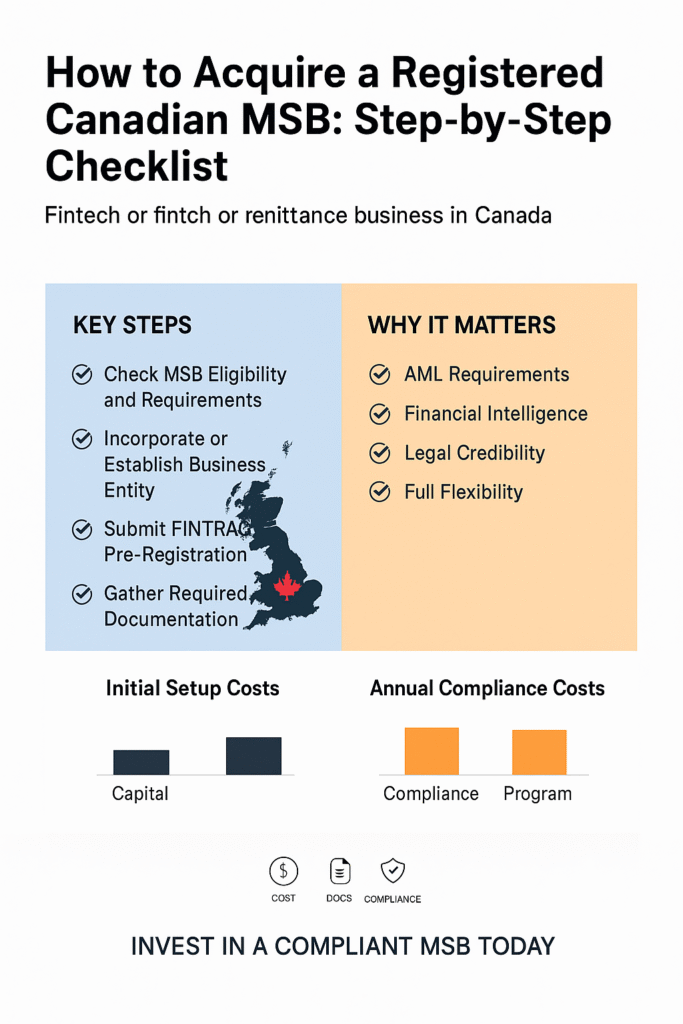
To operate legally as a fintech, remittance, or payment platform in Canada, you must register as a Money Services Business (MSB) with FINTRAC before offering any services. In fact, FINTRAC makes clear that MSBs must register with FINTRAC before beginning operations in Canada7baas.com. The following checklist walks through each major step — from confirming your MSB status to maintaining ongoing compliance — using best-practice guidance.
1. Check MSB Eligibility and Requirements
First, confirm that your business falls under Canada’s MSB definition. A Canadian MSB is any company located in or serving Canada that offers one or more of these services to the public on a commercial basis7baas.com7baas.com:
- Foreign exchange dealing: buying or selling currency (e.g. exchanging USD for CAD).
- Fund transfers/remittances: sending or receiving money domestically or internationally by any means (e.g. wire transfers, online payments, digital transfers).
- Issuing or redeeming money orders or traveller’s cheques: providing these instruments for customers.
- Dealing in virtual currencies: offering cryptocurrency exchange or custodial services.
If you perform any of the above services for Canadian customers, you need an MSB license7baas.com7baas.com. (Notably, even invoice/payment services that move customer funds can count as remittance under FINTRAC rules.) The law is broad: any firm that “remits or transmits funds by any means” is an MSB, so many payment processors or invoice platforms qualify. Importantly, foreign companies servicing Canadians are treated as Foreign MSBs (FMSBs) and must also register7baas.com. When in doubt, use FINTRAC’s self-assessment tool or err on the side of registering.
Tip: Canada is officially bilingual. All filings and communications with regulators must be in English or French, so arrange certified translations for any documents (e.g. criminal checks) not already in English/French.
2. Establish Your Canadian Entity and Governance
FINTRAC requires an MSB to be a Canadian-registered business (corporation, partnership, or branch). Set up your Canadian legal entity before registration and gather all formation documents. Key tasks include:
- Incorporate a Canadian company: Obtain a certificate of incorporation/registration and articles of incorporation showing your legal name and address7baas.com7baas.com.
- Open a Canadian bank account: Get a business bank account in Canada early on. (Banks will later verify your FINTRAC registration before processing MSB transactions.)
- Designate a Compliance Officer: Appoint a senior manager as your AML Compliance Officer (CAMLO) and document this in writing. FINTRAC expects every MSB to have a named compliance officer7baas.com7baas.com.
- Document ownership and management: Keep clear records of all directors, officers, and beneficial owners (anyone holding ≥20%). You’ll need names, addresses, dates of birth, and government IDs for all shareholders/directors7baas.com.
Each of the above will be needed in your FINTRAC application. For example, 7BaaS notes that FINTRAC asks for your incorporation certificate, shareholder register, and proof of beneficial ownership7baas.com7baas.com. Having these documents organized upfront (plus a corporate bank account statement) will streamline later steps.
3. Submit FINTRAC Pre-Registration Request
FINTRAC’s process begins with a brief pre-registration form (also called a “request to register”) submitted online. This is essentially a notification step. In the FINTRAC MSB portal, you’ll provide basic company information (legal name, address, main activities) and indicate which MSB services you offer. You will also supply initial estimates of transaction volumes for each service7baas.com. (Example: “We expect to do about $500K/year in international remittances and $200K in foreign exchange.”)
After submitting, FINTRAC will review the form and contact you via email or secure portal message. A FINTRAC compliance officer will reach out to confirm details and grant you access to the full MSB Registration System (MSBRS) portal7baas.com. This officer will provide any further instructions on completing the application. Note that this pre-registration step takes only days or weeks – its purpose is to kick off the formal process.
4. Gather Required Documentation
While waiting for FINTRAC’s response, compile all documentation needed for the full application. FINTRAC is strict: missing or illegible documents will delay you. Key items include:
- Corporate documents: Certificate of incorporation (and any amendments), articles, shareholder register, organizational structure, and any operating names7baas.com7baas.com.
- Ownership and ID records: Names, addresses, dates of birth, and certified government IDs for all directors, senior officers, and beneficial owners (≥20% shareholders)7baas.com. For any Canadian entity, collect criminal record checks for key individuals (directors/owners), and have them translated into English/French if needed7baas.com.
- Compliance Officer info: Prepare a formal letter or resolution that appoints your Compliance Officer (CAMLO), including their contact information7baas.com.
- Bank account details: List your business bank(s) and accounts that will be used for MSB transactions7baas.com. (FINTRAC will ask for this to verify your operations.)
- Business plan and activity description: Summarize your planned MSB activities and projected volumes. Outline the MSB services you will provide and the target markets.
- Locations and agents: Provide the physical addresses of your main office, branches, or agent locations (if any)7baas.com.
- Estimated transaction volumes: Have estimates ready for the annual dollar volumes of each MSB service (cash in/out, transfers, FX, etc.), as FINTRAC requests this in the application7baas.com.
Also assemble your draft AML/KYC policy documents (see next step) before filing. In short, double-check everything: FINTRAC’s checklist requires incorporation papers, IDs, criminal checks, compliance manual, etc., all in English/French7baas.com7baas.com.
5. Develop Your AML/KYC Compliance Program
By law, your MSB must have a formal written AML/ATF compliance program in place at the time of registration7baas.com. This program is the heart of your application. Key elements include:
- Risk assessment and policies: A documented analysis of your money-laundering and terrorist-financing risks. Define written policies and procedures for customer identification, due diligence, transaction monitoring, recordkeeping, and mandatory reporting7baas.com.
- Reporting procedures: Clear processes for filing required reports to FINTRAC. This includes identifying and submitting Suspicious Transaction Reports (STRs) and Large Cash Transaction Reports (LCTRs), as well as Electronic Funds Transfer Reports (EFTRs) for international transfers over C$10,0007baas.com. If you deal in crypto, plan for Large Virtual Currency Transaction Reports too.
- Compliance officer & training: Your designated CAMLO (from Step 2) should oversee the program. Implement ongoing staff training so employees know how to follow KYC/AML rules7baas.com7baas.com. 7BaaS specifically notes that you must have a compliance officer and regular training in your procedures7baas.com7baas.com.
- Independent audit: Establish a plan for an external review of your compliance program at least every 2 years7baas.com7baas.com. Document how you will conduct periodic effectiveness checks and update policies as needed. (FINTRAC requires a biennial audit by law7baas.com.)
Your AML manual (to be submitted) should cover these items in detail. For example, 7BaaS emphasizes including customer due-diligence rules, recordkeeping controls, and employee training plans as core components7baas.com7baas.com. Having this program drafted shows FINTRAC that you will meet ongoing obligations.
6. Complete and Submit the FINTRAC Registration Form
Once your FINTRAC contact has activated your portal access, log into the MSB Registration System and fill out the full application. Key tasks here:
- Create your MSBRS account and enter all business information (legal names, addresses, ownership structure) as requested.
- Select your MSB services: Indicate which MSB activities you will provide and the jurisdictions (Canada-wide).
- Upload supporting documents: Attach your compiled files – incorporation certificate, AML compliance manual, signed criminal checks, IDs, bank statements, etc. Use the portal’s secure upload function for each file.
- Designate the compliance officer: Confirm the name and contact of your CAMLO in the form (as you have on file).
- Review and submit: Carefully check that all required fields are filled (marked *). When everything is complete, submit the application electronically.
Importantly, there is no government fee to register an MSB7baas.com. 7BaaS notes that FINTRAC charges no registration fee, so the official cost is zero7baas.com (your costs will be internal preparation, legal advice, etc.). After submission, FINTRAC will review your application.
Timelines: Registration can take weeks or months. In practice, expect FINTRAC to process a complete application in 4–12 weeks7baas.com (a conservative industry estimate). They may send clarification requests in the meantime; respond promptly to avoid delays. Once approved, FINTRAC will assign you a unique MSB registration number and add your business to the public MSB registry.
7. Registration Costs and Payment-Provider Trade-offs
The good news: beyond preparation costs, FINTRAC does not charge a fee7baas.com. There is no government license fee to register your MSB. Your true costs are internal (legal/compliance staff time, AML software, independent audit fees, etc.).
Many startups initially use third-party payment platforms (PSPs) like Stripe, PayPal, or white-label processors because they can avoid immediate registration and setup. This approach can speed time-to-market, but it comes with trade-offs. PSPs typically charge transaction fees and may impose payment volume limits. More importantly, remember that PSPs themselves are often considered money transmitters under Canadian law – many PSP activities “fall within [FINTRAC’s] broad definition” of MSB transactionsblakes.com. In other words, using a PSP does not automatically exempt you from MSB obligations if you handle customer funds.
In summary, weigh flexibility vs. cost: Operating your own MSB requires full AML/KYC compliance (and its overhead) but gives you control and avoids PSP fees. Using a PSP defers AML burdens but limits flexibility and can be expensive per-transaction.
8. Notify FINTRAC (and Bank of Canada) of Changes
After obtaining your MSB registration, keep FINTRAC informed of any material changes to your business. This includes opening or closing branches, adding/removing MSB services, or changes in ownership or key management. FINTRAC requires you to update your registration within 30 days of any changefintrac-canafe.canada.ca. (You do this via the MSBRS portal using the “Change of Registration Information” form.) For example, if you change your business address or compliance officer, log in and submit an update requestfintrac-canafe.canada.ca. Failure to update may lead to penalties or even revocation of your registration.
Additionally, be aware of the Retail Payments Activities Act (RPAA). The RPAA (Bank of Canada law) requires many payment service providers to register with the Bank of Canada if they provide certain retail payment functions (holding funds, payment accounts, etc.). If your MSB offers payment-account services or settlement clearing, check RPAA registration rules as well – failure to comply can incur heavy fines. (This is a separate requirement from FINTRAC registration.)
9. Maintain Ongoing Compliance
Registration is not a one-time task. As a licensed MSB, you must actively maintain your AML/ATF program and reporting:
- Transaction monitoring and reporting: File STRs whenever you suspect money laundering or terrorist financing. Also submit Large Cash Transaction Reports for cash over C$10,000, and Electronic Funds Transfer Reports for international transfers over C$10,0007baas.com. If dealing in crypto, file Virtual Currency Transaction Reports as required.
- Record-keeping: Keep detailed records of all MSB transactions and client ID information for at least five years7baas.com. Maintain logs of every report filed. These records must be readily retrievable for audits.
- Ongoing KYC and monitoring: Continuously monitor customer transactions and update CDD profiles. Verify client identities as mandated under your program. (Your risk assessment and policies should evolve with your business.)
- Periodic audit/review: Conduct an independent audit of your AML program at least every two years7baas.com. Use the findings to improve controls. (FINTRAC expects a biennial review as part of your compliance framework.)
- Staff training: Provide regular AML training to all relevant employees, updating training whenever regulations change7baas.com. Well-trained staff help ensure ongoing compliance.
Keep your FINTRAC registration number readily available, as banks and partners will often request it to verify your legitimacy. Remember that FINTRAC may audit MSBs at any time, so maintain an organized audit trail of policies, reports, and record logs7baas.com7baas.com. Staying vigilant on these obligations will protect your license. Failure to report or maintain records can lead to administrative penalties and enforcement actions.
By following this checklist — confirming MSB status, forming your Canadian entity, submitting the proper FINTRAC forms with complete documentation, and implementing a robust AML program — you can achieve and uphold your Canadian MSB registration. Compliance is ongoing, but a registered MSB opens doors to banking relationships and customer trust in the Canadian market.
References: Authoritative sources for this checklist include FINTRAC’s official guidance and industry resources. For example, 7BaaS’s Canadian MSB guides explicitly list the required services and document checklists7baas.com7baas.com, emphasize the compliance program requirements7baas.com7baas.com, and note that FINTRAC registration has no fee7baas.com. FINTRAC itself instructs registrants to update any changes within 30 daysfintrac-canafe.canada.ca. These guidance documents underpin the steps outlined above. (All cited information above is drawn from official FINTRAC and 7BaaS publications.)