Global money services regulations are converging in 2025, making MSB licensing a critical step for fintechs expanding internationally. Any fintech that moves money through payments, remittances, currency exchange or digital wallets, typically falls under MSB (Money Services Business) rules. For example, U.S. regulators note that “any fintech moving money domestically or cross-border may qualify as a money services business”. This guide explains what an MSB license entails, the benefits of being licensed, and highlights the top jurisdictions worldwide for obtaining an MSB or equivalent license in 2025. Readers will learn how to choose the right country for expansion, how to apply, and how to overcome common regulatory challenges.
Understanding MSB Licensing
An MSB license is essentially a legal registration or permit that allows a company to offer money-transfer and related financial services. Globally, MSB licensing goes by different names – for example, in Europe it may be called a Payment Institution or Electronic Money Institution (EMI) license, while in Hong Kong it is a Money Service Operator (MSO) license. In all cases, the goal is the same: to ensure the firm complies with anti-money laundering (AML) and counter-terrorist financing (CFT) laws. For instance, a business providing remittances or currency exchange must typically have an MSB license to operate legally. In the U.S., each MSB must register with the Treasury’s Financial Crimes Enforcement Network (FinCEN) by filing FinCEN Form 107 within 180 days of establishment. That federal registration (renewed every two years) complements state-level money transmitter licenses in many cases. Globally, the definition of an MSB varies by jurisdiction, but it generally covers payments, currency exchange, issuances of money orders or stored value, and related services.
Benefits of Obtaining an MSB License
Getting an MSB license unlocks key advantages for a fintech:
- Legal authorization and market access. A license grants legal authority to conduct currency exchange, remittance, and other payment services. For example, Luxspin Global Holding recently obtained a U.S. MSB license, which “grants legal authority to conduct currency exchange, remittance, and other financial services” nationwide. Operating without a license risks heavy penalties, whereas a license legitimizes the business.
- Regulatory compliance and trust. Licensed MSBs must meet rigorous AML/CFT standards, which builds trust with banks, partners, and customers. U.S. MSB regulations require robust customer identification, transaction monitoring, and reporting of suspicious activity. Being licensed signals to partners and investors that the fintech meets industry compliance benchmarks.
- Banking and payment integration. Many banks and payment networks only work with regulated entities. Holding a recognized MSB license makes it easier to open banking accounts, connect to payment rails, and integrate with global financial systems.
- Operational efficiency (U.S. multistate). In the U.S., a single-state money transmitter license can be very limiting. New uniform standards like the Money Transmission Modernization Act (MTMA) are harmonizing requirements across states. As of 2025, “31 states have now adopted or partially adopted [the MTMA] including major jurisdictions like California, New York, Florida, and Texas,” with standardized capital, bond, and documentation requirements. This uniformity makes multistate licensing “faster, more predictable, and less costly” for fintechs. Pursuing a coordinated multistate strategy therefore offers scale efficiencies compared to isolated state licenses.
Overall, an MSB license enables growth by ensuring compliance, expanding market access, and facilitating partnerships. Licensed status also reassures customers and regulators that the business has in place the necessary AML policies and risk controls.
Global Jurisdictions for MSB Licensing (2025)
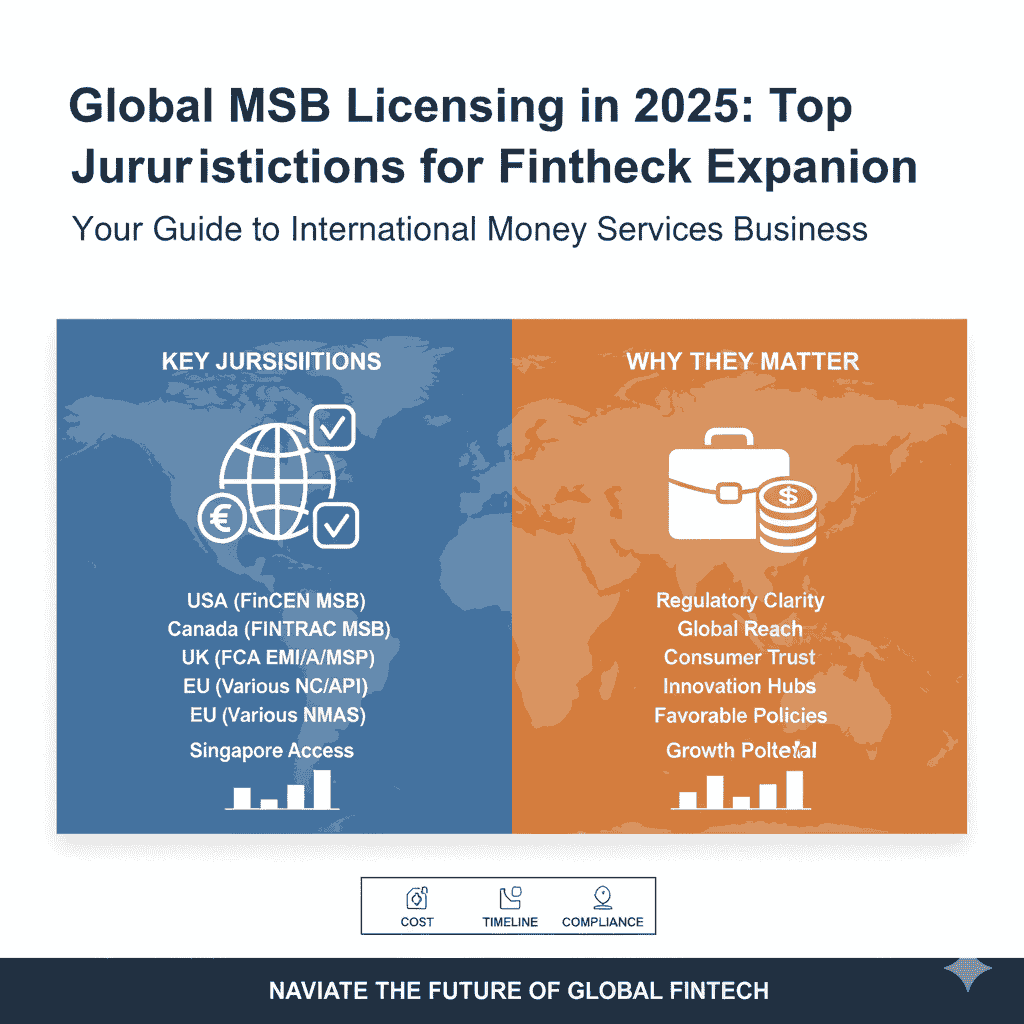
Fintech founders should consider several leading jurisdictions when expanding with an MSB license. Key options include:
- United States (FinCEN and States). The U.S. remains a top market. All MSBs must register with FinCEN (as noted above). In addition, most states require separate money transmitter licenses for remittances or payment services. While this was once highly fragmented, the MTMA is creating consistent national standards. Major states (CA, NY, FL, TX, etc.) have aligned requirements for net worth, surety bonds and exams. This trend means a coordinated multistate MSB license can now be obtained more efficiently. Fintechs targeting U.S. customers should plan for both the federal FinCEN registration and the necessary state licenses in their target regions.
- Canada. Canada offers a stable environment for MSBs. Any business providing money transfers, currency exchange or virtual currency services into Canada must register with FINTRAC (Canada’s financial intelligence unit) before starting operations.. Notably, FINTRAC does not charge a registration fee, making the process relatively straightforward. The basic requirements are to establish a compliance program (including AML/CFT policies and customer due diligence) and report transactions per FINTRAC rules. According to industry guides, “Canada is one of the most popular jurisdictions for obtaining an MSB license,” thanks to its developed financial infrastructure and clear regulatory framework.
- United Kingdom (FCA/HMRC). In the UK, money service businesses must navigate both the Financial Conduct Authority and HM Revenue & Customs. By law, a UK MSB providing remittance or currency exchange must be authorized as a Payment Institution (under PSD2) by the FCA before registering for AML compliance with HMRC. In practice, this means fintechs first secure FCA approval (receiving a firm reference number) and then use that to complete their HMRC anti-money laundering . The UK also has robust AML requirements and a comprehensive regulator, which makes it a reputable market. A licensed UK entity can serve as a gateway to the European market (subject to post-Brexit rules) and the broader Commonwealth.
- European Union. MSB licensing in the EU falls under the Payment Services Directive (PSD2) and E-Money Directive. A fintech can apply for either a payment institution or e-money institution license in any EU member. Once authorized, those licenses are passportable across the EU/EEA. For example, obtaining an Electronic Money Institution (EMI) license (common in Malta, Lithuania, etc.) permits Eurozone-wide service under harmonized rules. Note also that the upcoming Markets in Crypto-Assets (MiCA) framework is tightening crypto-related licensing in the EU. In general, Europe’s single-market approach and clear regulators make it an attractive region, though capital and compliance standards (e.g. MiCA thresholds) can be stricter than in some other regions.
- Singapore. As a leading fintech hub, Singapore requires payment and remittance providers to hold a Payment Services Act (PSA) license. The PSA (in full effect since 2021) mandates three license types: money-changing, Standard Payment Institution, or Major Payment Institution, depending on the services and volumes. For most MSB activities, a fintech will need either a Standard or Major PSP license. These licenses have minimum paid-up capital requirements (e.g. S$100,000 for Standard, up to S$1M for Major) and strict fit-and-proper checks. Singapore’s regulator (MAS) also imposes ongoing safeguards (such as customer KYC, escrow accounts, and annual audits). Obtaining a Singapore PSP license is time-consuming and costly, but it grants access to Southeast Asian markets and carries global prestige.
- Hong Kong. Hong Kong’s MSO licence is mandatory for any business doing currency exchange or remittance there. The licence is issued under the Anti-Money Laundering Ordinance, overseen by the Customs & Excise Department. Key requirements include a compliance framework, designated MLRO, and passing a local competence exam. Notably, Hong Kong does not impose a minimum capital threshold for the MSO licence (unlike some PSP regimes). This makes it relatively accessible for startups with solid AML policies. The MSO licence is valued as a gateway to the broader Asian market, given Hong Kong’s status as a financial center.
- Middle East (UAE, etc.). The UAE (Dubai’s DFSA/DIFC and Abu Dhabi’s ADGM) has become very fintech-friendly. These free zones offer payment services licenses under their own financial regulator with clear frameworks. Other Middle Eastern markets like Bahrain also have open licenses for digital payments. Fintechs often look to the UAE for regional expansion due to low taxes and growing fintech investments. However, these licenses usually require substantial capital and local presence, so they are best for well-funded startups targeting MENA customers.
- Others to watch. In addition to the above, some smaller jurisdictions are optimizing fintech licensing. For example, Lithuania and Malta in the EU offer fast-track EMI/PSP licenses. Certain Caribbean and Pacific jurisdictions (e.g. Bermuda, Labuan in Malaysia) advertise quick MSB/PSP licenses for international firms. Each has pros and cons (speed and privacy vs. banking access and reputation), so careful due diligence is essential.
The map above highlights key global fintech centers. While many major financial hubs (New York, London, Singapore, Hong Kong) offer robust licensing frameworks, emerging fintech cities (e.g. Austin, Lagos, Bangalore) are also gaining attention. When choosing a jurisdiction, fintechs must weigh factors like market size, regulatory burden, and strategic goals. For example, North American and European markets offer large customer bases but higher compliance standards, whereas some Asian or Middle Eastern regimes may offer easier entry at the cost of stricter capital requirements.
How to Apply for an MSB License with 7BaaS
Navigating MSB licensing is complex, but a structured process helps. 7BaaS’s licensing experts typically follow these steps:
- Initial assessment. Review the business model to identify required licenses (MSB, payments, crypto, etc.) in each target country. 7BaaS helps determine whether you need a money transmitter license, EMI/PSP, or both, and outlines each regulator’s criteria.
- Prepare documentation. Draft the required materials: a detailed business plan, AML/CFT policies, customer due-diligence procedures, and financial projections. For instance, regulators expect a compliance program, risk assessments, and evidence of internal controls. 7BaaS guides clients through completing all forms (e.g. FinCEN 107 in the U.S.) and assembling supporting documents like resumes of key personnel.
- Capital and bonding. Arrange any required capital, surety bonds or security accounts. Some jurisdictions (e.g. Singapore, EU) have minimum capital rules for licensed PSPs. In the U.S., bonds may be required per state based on transaction volume. 7BaaS can advise on meeting these financial requirements.
- Submission and liaison. File the application with the regulator(s). 7BaaS coordinates the submission of applications to FinCEN, HMRC, MAS, etc., and tracks the review process. We respond to regulator inquiries and provide any additional information needed.
- Post-license setup. Once approved, fulfill any post-licensing steps: opening local bank accounts, reporting system setup, employee training, and ongoing compliance. 7BaaS assists with implementation and can provide managed compliance services if needed.
By following this process, fintechs streamline their licensing journey. (For similar steps on e-money licensing, see our [EMI Licensing] service page or the EMI vs MSB Licensing blog.) With professional support, startups avoid common pitfalls and can often reduce the overall timeline.
Common Challenges in MSB Licensing
Even with a plan, MSB licensing comes with hurdles:
- Fragmented regulations. Each jurisdiction has its own definitions and rules. For example, U.S. state laws differ on disclosures, bonding and reporting, and a lack of planning can create “regulatory debt” for companies expanding interstate. Globally, fintechs must navigate diverse standards – what passes in one country may not in another. This complexity requires careful legal guidance and flexibility.
- Rigorous compliance requirements. Regulators expect comprehensive AML/CFT systems. Applications often require detailed documentation: board meeting minutes, audit reports, KYC logs, transaction monitoring setups, etc.. After licensing, ongoing requirements include periodic reporting, audits, and keeping records (often for 5–7 years). Maintaining this level of compliance demands resources and expertise.
- High costs and time. Licensing fees, legal fees, bonding, and capital requirements can be substantial. For instance, standard U.S. money transmitter license bonds start around $50k–$100k and can run into millions as volumes grow. Singapore or EU licenses require six-figure capital reserves. The application process itself can take 3–12 months per jurisdiction. Startups must budget accordingly.
- Ever-changing rules. Fintech is a moving target. New regulations (e.g. the EU’s MiCA for crypto, revised AML directives, digital asset rules) can change the licensing landscape mid-process. Companies should anticipate updates. For example, all EU MSBs must soon comply with MiCA’s crypto-asset rules, and U.S. regulators continue refining guidance on virtual currency MSBs. Staying abreast of changes is critical.
Despite these challenges, the right preparation makes MSB licensing feasible. Partnering with experts can turn these hurdles into manageable tasks.
Conclusion
Global MSB licensing in 2025 is both a necessity and an opportunity for fintech startups. By securing the proper money-transmitter or payment services licenses, companies gain legal authority, customer trust, and market reach. The top jurisdictions — the U.S., Canada, UK/EU, Singapore, Hong Kong, and others — offer clear frameworks but require strict compliance. Understanding each market’s rules (from FinCEN registration to FINTRAC rules to FCA/HMRC mandates) is essential. Although the process is complex, fintechs that plan carefully and seek expert help can launch internationally with confidence. For tailored guidance on MSB or EMI licensing, 7BaaS offers turnkey consulting and application support. Contact 7BaaS today to start your licensing journey and ensure your fintech expansion meets all global regulatory standards.
FAQs
- What is an MSB license and who needs it?
An MSB (Money Services Business) license is a regulatory registration for companies that transmit funds, exchange currencies, or handle financial instruments like money orders or stored value. Any fintech that provides domestic or international payment, remittance, or currency exchange services typically needs an MSB license in its operating jurisdiction. This includes crypto-payment and e-wallet providers in many cases.
- Which countries or regions require MSB registration?
Most developed markets have MSB rules. For example, the U.S. requires all MSBs to register with FinCEN and often obtain state money transmitter licenses. Canada requires FINTRAC registration.. The UK requires FCA authorisation and HMRC AML. In the EU, similar services need a payment or e-money license under PSD2. Major Asian hubs like Singapore (Payment Services Act license) and Hong Kong (MSO license) also enforce registration.
- How long does it take to get an MSB license?
Timelines vary. In the U.S., FinCEN registration is typically completed within days of filing, but state licenses can take 3–9 months per state. FCA authorization in the UK can take 6–12+ months, and MAS approval in Singapore often takes 6–9 months. Overall, a global MSB strategy can require 6–18 months depending on jurisdiction count and readiness. Working with experts can reduce delays by ensuring all documents are complete.
- What are the key requirements for obtaining an MSB license?
Common requirements include: maintaining a certain net worth or capital buffer; implementing a robust AML/CFT compliance program; appointing a qualified Money Laundering Reporting Officer (MLRO) or compliance officer; detailed business plans and policies; secure IT systems; and often a surety bond or trust account. For example, Hong Kong’s MSO license demands a fit-and-proper test for directors and an AML/CFT policy. Canada and the U.S. require record-keeping and reporting systems. Preparing these in advance is crucial.
- What are the benefits of being licensed as an MSB?
An MSB license allows a fintech company to legally offer payment and remittance services, which builds credibility with customers and partners. It also enables access to banking and payment networks that typically require regulated status. Additionally, licensed companies are seen as low-risk by regulators and banks, which can lead to better terms on banking relationships. Finally, compliance with licensing requirements demonstrates to investors and users that the company is committed to operating safely and lawfully