
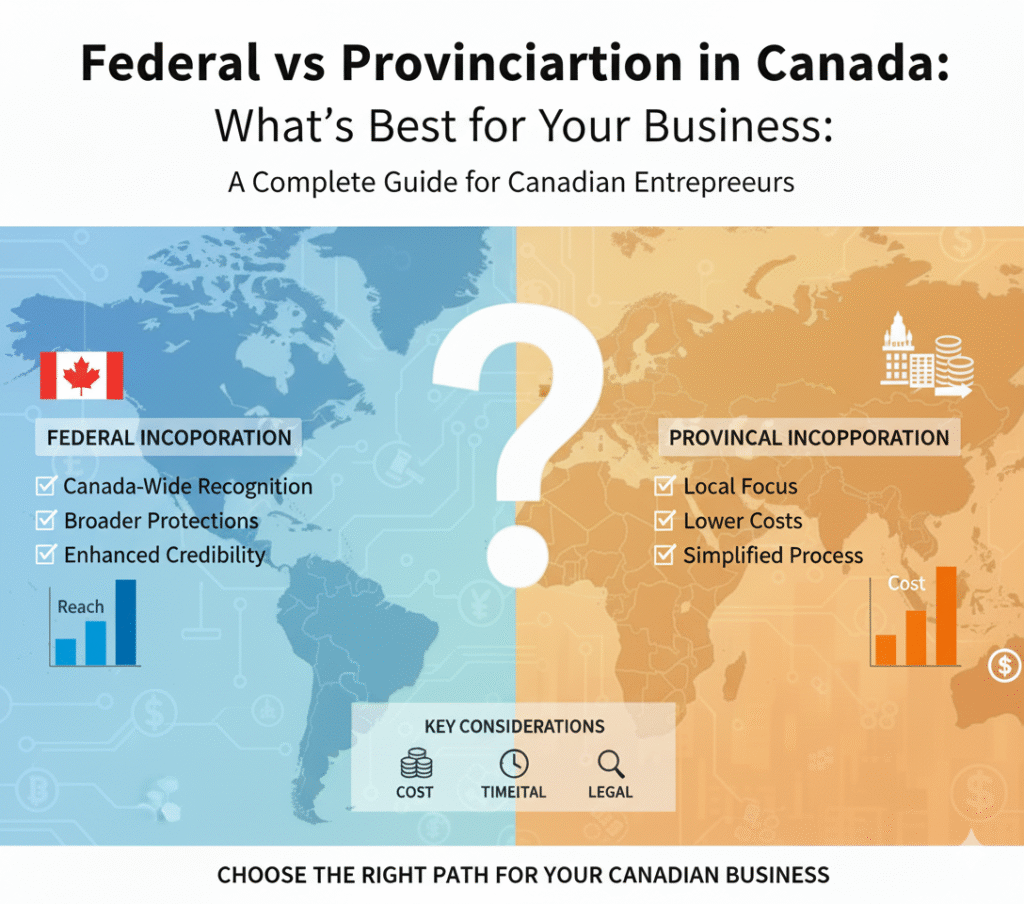
In Canada, entrepreneurs must decide whether to incorporate federally or provincially – a choice that impacts name protection, expansion, costs and compliance. Federal incorporation (under the Canada Business Corporations Act) creates a corporation that can operate coast-to-coast, while provincial incorporation ties your company to one province’s laws. Each path has trade-offs: federal offers national name rights and mobility, whereas provincial often means simpler processes and lower fees for local businesses. This guide explains the differences, advantages and drawbacks of each option so you can choose the structure that best fits your goals.
What Is Federal Incorporation in Canada?
Federal incorporation means registering under Canada’s national law (the Canada Business Corporations Act). Federally incorporated companies can use their name and do business in any province or territory without additional incorporation. For example, Corporations Canada notes that when a federal name is approved it’s “protected across the country”, and federally incorporated companies can carry on business anywhere in Canada without regional restrictions. This provides nationwide brand protection and recognition. Federal corporations must meet certain requirements: for instance, at least 25% of directors must be Canadian residents (though some provinces now permit 100% foreign directors). Official documents are often bilingual (English/French), signaling prestige.
Advantages of Federal Incorporation:
- National Reach & Name Protection: You gain nationwide business scope and exclusive use of the corporate name across Canada. This is valuable if you plan multi-provincial or international expansion.
- Trademark & Share Flexibility: Federal corps can more easily secure a trademark across Canada. They also often allow flexible share transfers, which appeals to investors (facilitating selling or adding partners).
- Streamlined Online Process: Corporations Canada offers an online incorporation service, making filings and updates fast and centralized.
Considerations for Federal Incorporation:
- Higher Costs: Federal fees are modest (about $200 online plus name search), but you may incur more administrative or service costs. Professional services often charge extra.
- Stricter Compliance: Federal corporations face rigorous reporting and governance rules. You still need extra-provincial registration in every province where you carry on business, which adds paperwork. (In fact, one legal guide warns that a federal corp must “also be provincially incorporated in which it primarily conducts business”.)
- Residency Requirement: By law, a percentage of directors must be Canadian residents (typically 25%), which can affect foreign-owned startups.
“Federally incorporated companies can carry on business anywhere in Canada, and there are no restrictions regarding the province or territory…” – Government of Canada
What Is Provincial Incorporation in Canada?
Provincial incorporation means registering your business under the laws of a specific province (or territory), such as Ontario’s Business Corporations Act or the British Columbia Business Corporations Act. This creates a corporation whose rights and obligations are governed by that province alone. The company name is protected only within that province, so another business in a different province could use the same name.
Many provinces allow 100% foreign ownership (e.g. B.C. and New Brunswick do) and have no Canadian-director requirement. Registration is typically handled through the province’s business registry, often faster or simpler for local companies. You must still register extra-provincially if you expand beyond the home province.
Advantages of Provincial Incorporation:
- Lower Fees & Simpler Process: Provincial startup costs and annual requirements tend to be lower. It’s often faster and cheaper for a business focused on one market. For example, typical provincial fees range $300–$500 total, comparable to or slightly higher than the federal base fee, but you avoid federal bilingual requirements.
- Local Focus: Provincial law is tailored to local businesses. Small and medium enterprises (SMEs) with no immediate national plans often find provincially incorporating “more practical”. You align directly with the regulatory environment of your target market.
- Flexible Ownership: Some provinces now allow all directors to be non-residents (e.g. B.C., New Brunswick), which can be advantageous for international founders.
Considerations for Provincial Incorporation:
- Limited Scope: The corporation can only operate under that province’s jurisdiction without extra registration. If you sell outside the province, you may need to register as an extra-provincial corporation in each new province, or incorporate again. In practice, “if you foresee doing business in multiple provinces or internationally, federal incorporation may be worth the extra steps”.
- Name Protection: Your company name is only protected provincially. A competitor could use the same name in another province. You lose the nationwide brand security that comes with federal status.
- Credibility & Grants: Some investors or large clients view federal corps as more established. Additionally, certain federal grants or government programs may be geared toward federally incorporated firms.
“Provincial incorporation is a cost-effective and straightforward option, ideal for businesses with a localized focus, however, it is limited to provincial boundaries…” – Epstein & Associates
Key Differences: Federal vs Provincial
When choosing, consider these main factors:
- Business Scope & Growth Plans: Will you do business outside one province? A federal corporation can seamlessly operate nationwide. If you plan only local or regional sales, provincial may suffice.
- Name Protection: Federal registration grants exclusive use of your corporate name across Canada. Under provincial incorporation, the name is exclusive only in that province.
- Costs & Fees: Federal online fees start at about $200 plus a $60 name search. Provincial fees typically range $200–$500 (e.g. Ontario ~$360 total). Factor in extra-provincial registration fees if expanding provincially. (In general, provincial incorporation is often cheaper for a single location.)
- Compliance & Administration: Federal compliance can be more onerous with bilingual filings and higher governance standards. Provincial compliance is usually simpler, though you must track multiple filings if registered extra-provincially.
- Directorship Requirements: Federal law requires 25% Canadian directors. Provinces vary: some (B.C., N.B.) require none; others (Alberta, Ontario) require Canadian residents.
- Investor Perception: Federal incorporation is often seen as a mark of prestige and national ambition, which may appeal to investors or partners seeking national operations. Provincial incorporation is viewed as more local.
Here’s a quick comparison:
- Federal (CBCA): National scope, nationwide name protection, higher fees, stricter rules (25% Canadian directors), good for cross-Canada expansion.
- Provincial (e.g. OBCA): Local focus, name protected in one province, lower initial cost, simpler filing, allows province-specific rules (some allow 100% foreign directors).
Which Incorporation Path Should You Choose?
The best choice depends on your business goals. As the Business Development Bank of Canada (BDC) advises, small local businesses often incorporate provincially, while those with national/international ambitions go federal. Specifically:
- If you plan to grow beyond one province (open multiple locations or sell Canada-wide), federal incorporation is often worth the extra compliance steps. You’ll benefit from a single corporation structure and consistent name usage.
- If you are a small or medium business serving a local market without plans to expand soon, provincial incorporation can save money and time. It aligns better with a regional strategy and simpler regulations.
In either case, consult experts to ensure your corporate structure and regulatory obligations are met. Firms like 7BaaS offer Company Formation Services and startup guidance to navigate these rules. For example, 7BaaS can handle the incorporation process and explain whether a federal or provincial registration makes sense for your fintech, crypto or financial services venture. After incorporation, remember to register for a Business Number (CRA tax accounts) and extra-provincial licenses as needed.
Conclusion
Federal and provincial incorporation each serve different needs. Federal incorporation provides cross-country flexibility, stronger name protection and possibly easier investor appeal – ideal for businesses eyeing growth across Canada. Provincial incorporation offers simplicity, cost savings and alignment with local operations, which can be perfect for regionally-focused startups. Entrepreneurs should weigh factors like expansion plans, budget and compliance workload. A professional service like 7BaaS can help analyze your situation, assist with paperwork, and ensure your business structure is optimized for success in Canada.
Take the next step: Whether you choose federal or provincial incorporation, expert guidance ensures your paperwork is filed correctly and timely. Contact 7BaaS today for personalized assistance with company formation and regulatory compliance, so you can focus on growing your business with confidence.
FAQs
Q: What is federal incorporation in Canada?
A: Federal incorporation means registering your company with Corporations Canada under the Canada Business Corporations Act (CBCA). A federal corporation can operate in all provinces and territories under one corporate entity. It grants national name protection and uniform governance across Canada.
Q: What is provincial incorporation?
A: Provincial incorporation means registering your business under the laws of a specific province (e.g., Ontario, British Columbia). The company is subject to that province’s corporate act. The corporate name is protected only within that province. Provincial incorporations often have lower fees and simpler requirements for local businesses, but limited regional scope.
Q: Which is better: federal or provincial incorporation?
A: It depends on your needs. If you expect to do business across multiple provinces (or require national trademark protection), federal incorporation is usually best. If you only operate in one province and want a simpler, cost-effective setup, provincial incorporation may be sufficient. Consider factors like expansion plans, cost, and compliance burdens when deciding.
Q: Can a provincial corporation expand into other provinces?
A: Yes, but it must register as an “extra-provincial” corporation in each new province where it does business. This means obtaining extra-provincial licenses or filings, and possibly using a different name if the original name isn’t available elsewhere. By contrast, a federally incorporated company is already recognized in all provinces, simplifying expansion.
Q: How much does incorporation cost in Canada?
A: Fees vary. Federal online incorporation is about $200 plus the NUANS name search fee (~$60). Provincial fees depend on the province (e.g. Ontario ~$360 total, Alberta ~$500 total). Provinces typically range $200–$400. Federal filings may also incur translator costs or legal fees for bilingual documents. Expect total government fees in the low hundreds; legal or service fees can add more if you hire help.
Q: Do I need a lawyer or agent to incorporate?
A: Legally, anyone can file incorporation documents online. However, due to the complexities (name search, regulatory compliance, director requirements), many businesses use professional services. Expert advisors like those at 7BaaS ensure the correct filings for your chosen jurisdiction, help with ongoing compliance, and can even act as your registered agent if needed.