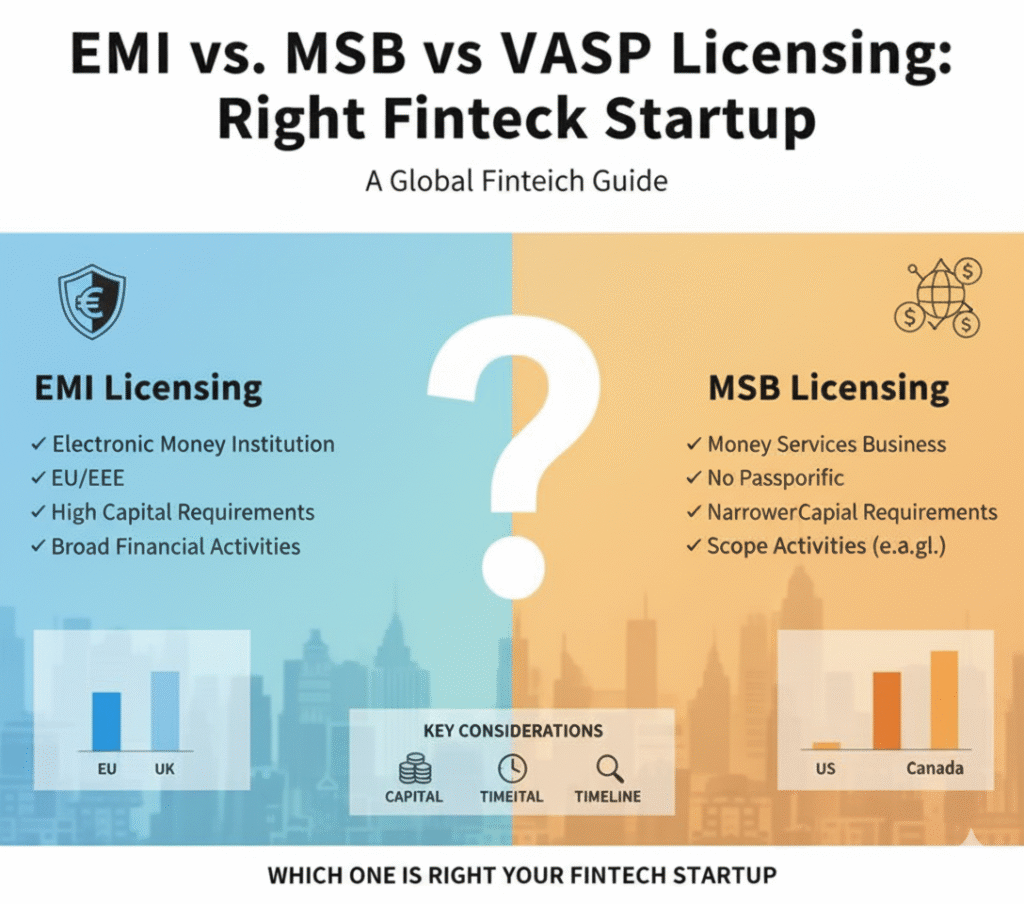
Fintech startups expanding into payments or remittance services must navigate complex licensing rules. Two common options are Electronic Money Institution (EMI) licenses and Money Services Business (MSB) registrations. An EMI license (common in Europe/UK) allows a firm to issue and manage e-money (digital cash for wallets, prepaid cards, and payment accounts). In contrast, an MSB registration (used in North America and other regions) covers services like currency exchange, money transfers, and issuing money orders. Understanding each path’s requirements and use cases is crucial. Below we define each license type, compare their scope, and highlight how to choose the best fit for your financial platform.
What Is an EMI License?
An Electronic Money Institution (EMI) license permits a company to issue and manage electronic money and provide related payment services. Electronic money is essentially digital cash stored on cards or apps for online transactions. EMIs sit between traditional banks and the modern cashless economy, focusing on fast, user-friendly digital payments. Key EMI services include:
- Issuing e-money: Convert fiat currency into digital money that customers can use for transactions.
- Managing payment accounts: Open and operate customer payment or digital wallet accounts for transfers and purchases.
- Executing payments: Process online transfers, peer-to-peer (P2P) payments, and bill payments on behalf of users.
- Multi-currency wallets: Provide accounts allowing users to hold and exchange multiple currencies easily.
EMIs cannot offer traditional banking services like loans or interest-bearing accounts. By regulation, EMIs must safeguard customer funds in segregated accounts. This means client money is kept separate from the company’s own funds, protecting users even if the EMI fails. In short, EMIs focus on payment innovation and e-money – not lending or investment products.
EMI Licensing Jurisdictions (UK & EU)
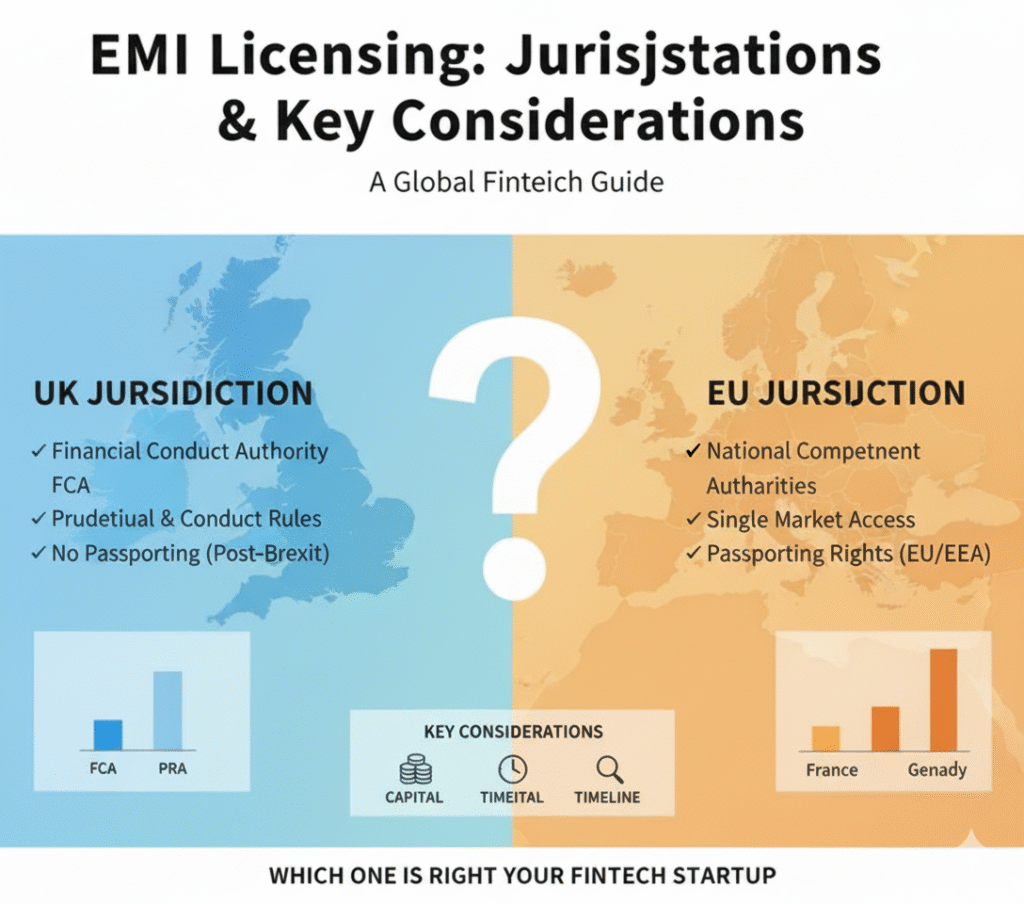
EMI licenses are primarily issued under the European e-Money Directive (EU) or equivalent UK regulations. For example, in the UK the Financial Conduct Authority (FCA) authorizes EMIs. Key points:
- UK EMI License: The FCA requires a formal application via its Connect portal. A full EMI license needs at least €350,000 in start-up capital, and the process typically takes 6–12 months. The FCA also charges an application fee (~£5,000) and demands extensive documentation (often 30+ policies on risk, AML, IT security, etc.).
- EU EMI License: EU countries like Lithuania, Ireland, Germany, etc. follow PSD2/EMD rules. They likewise require around €350,000 capital for a full EMI, but fees are comparable (€5k–10k) and timelines can range 9–18 months depending on the regulator. Lithuania is known for faster approvals, while some authorities (e.g. BaFin in Germany) may take longer. The big advantage is EU passporting – once licensed in one EU/EEA state, the EMI can offer services across the entire single market.
How to apply for an EMI license in the UK: In practice, you prepare a detailed business plan and compliance manual and submit via FCA Connect. The FCA’s “Payment Services Regulations” application form is online, and firms must demonstrate a robust AML/CFT program. Consulting firms (like 7BaaS) note that the FCA often requests clarifications, so planning for a year-long process is wise.
EMI key requirements: high capital (€350k), strong governance (experienced directors/compliance), detailed IT and safeguarding procedures.
EMI licenses are ideal for fintechs building digital banking services: e-wallet providers, challenger banks, payment platforms, and fintech apps that need to hold customer funds. With an EMI, you gain the credibility of a regulated entity and can scale across Europe, but you face significant upfront costs and complex compliance.
What Is an MSB License?
A Money Services Business (MSB) license (or registration) is the term used in North America and some other regions for firms that deal in money transfer or currency exchange services. In the U.S. and Canada, MSBs must register with the national regulator (FinCEN in the U.S., FINTRAC in Canada) and comply with anti-money-laundering laws. FinCEN broadly defines an MSB as any business “doing business… in one or more of” these capacities:
- Currency exchange (buying/selling foreign cash)
- Check cashing (converting checks to cash)
- Issuing or selling traveler’s checks, money orders, stored-value cards
- Money transmission (sending transfers domestically or internationally)
- (In the U.S., the U.S. Postal Service is explicitly included.)
In plain terms, an MSB handles currency conversion, remittance transfers, prepaid instruments, or related services. Examples include Western Union–style remittance companies, crypto exchanges (often as MSBs), foreign exchange bureaus, or check-cashing shops.
MSBs are subject to strict license compliance requirements: they must implement an AML/KYC program, designate compliance officers, conduct risk assessments, and file reports (like Suspicious Activity Reports) under laws like the U.S. Bank Secrecy Act or Canada’s PCMLTFA. In other words, MSBs focus heavily on compliance with anti-money-laundering (AML) rules, whereas EMIs follow payment-services regulations.
MSB Licensing Jurisdictions (US & Canada)
- USA: U.S. money transmitters must register with FinCEN (no fee) and renew every two years. This federal registration is straightforward (FinCEN’s site guides the simple online form). However, MSBs must also obtain state-level money transmitter licenses in each state where they operate, which involves fees, bonding, and separate applications (making U.S. licensing complex).
FinCEN notes clearly: “There is no cost for [MSB] registration”. So the only expenses are getting your compliance program in place and any state license costs. Once registered, U.S. MSBs must abide by BSA/AML rules (transaction monitoring, SARs, etc.). - Canada: In Canada, all MSBs must register with FINTRAC. Like the U.S., Canada’s MSB registration carries no government fee, but companies must submit their information and compliance program. Notably, Canada’s rules do not impose any minimum capital requirement. This makes Canada an attractive jurisdiction for startup MSBs. FINTRAC covers services such as foreign exchange, funds transfer/remittance, money orders/traveler’s cheques, and even virtual asset dealing (some crypto-related services).
“Canadian registration is incomparably easier and cheaper to obtain and maintain,” one industry consultant notes. Only a single FINTRAC MSB registration is needed to operate nationwide.
Other countries with MSB-style regimes include Australia (registration with AUSTRAC), certain Middle East/Asia nations (with their own remittance rules), and numerous US states. In each case, the focus is on AML compliance.
MSB key requirements: AML/KYC program, reporting to regulator, and possibly local director or office. Generally no capital minimum (unlike EMIs).
EMI vs MSB use cases: Choose EMI for account-based digital payments (e-wallets, app-based banking) especially in Europe/UK. Choose MSB for remittance, currency exchange, or crypto/transfers primarily in North America or similar markets.
EMI vs MSB: Key Differences
Here’s how EMI licenses and MSB registrations compare on core factors:
- Permitted Services: An EMI can issue e-money, manage digital wallets/accounts, and process payments (including cross-border transactions). However, EMIs cannot extend credit or engage in banking activities beyond payments. In contrast, an MSB covers money transmission, currency exchange, and issuing/redeeming payment instruments. Notably, MSBs often include crypto-related services under one license (e.g. virtual currency dealing or custody in Canada). In Europe, handling crypto requires a separate VASP or crypto license, whereas some MSB regimes bundle it with traditional money services.
- Regulatory Regime: EMI licenses are granted by banking/payments regulators (e.g. FCA UK, European Central Bank delegates). They fall under payment-services laws (PSD2, EMD2) with a strong focus on safeguarding customer funds and operational controls. MSB registration is usually under anti-fraud laws (BSA in US, PCMLTFA in CA). MSBs are overseen by financial crime units (FinCEN, FINTRAC, state regulators) with rules like risk assessments and transaction reporting.
- Capital & Costs: EMIs require significant initial capital (commonly €350,000 for a full EMI license). There are also application and ongoing fees (UK FCA ~£5K initial fee) plus costs of maintaining compliance (audits, systems, etc.). By contrast, MSB registration typically has no mandated capital. For example, Canada imposes no capital requirement, and U.S. MSB registration itself is free (though states may require bonds). The main MSB costs are compliance infrastructure (software, officers, audits).
- Timeframe: EMI authorizations are lengthy. FCA cites 6–12 months (or longer if incomplete); EU regulators often take up to 15 months. MSB registration is generally quicker: FinCEN requires registration within 180 days of business start (and it’s largely form-based), and FINTRAC registration can be immediate once documentation is ready. However, obtaining U.S. state licenses can add months of processing per state.
- Geographic Scope: An EMI in the EU/UK can serve customers across member states via passporting rights. An MSB license is country-specific (or even state-specific in the U.S.); you’ll need separate approvals to operate internationally. In practice, a UK/EU startup might pick EMI to access Europe, whereas a North American startup would choose MSB to serve local markets.
- Compliance Burden: EMI compliance tends to be more complex and expensive, reflecting banking-level scrutiny. MSBs have heavy AML obligations, but less upfront regulatory friction (no big capital tests). Both must maintain strong AML/KYC, but EMIs also juggle data protection and payment security laws.
Where and How to Apply
How to apply for an EMI license in the UK: Start by forming a company in the UK (FCA requires a UK-registered entity and often UK-based directors or a local representative). Prepare your FCA application package: this includes a business plan, risk assessments, 30+ policies (on AML, IT security, operations, etc.), evidence of capital, and details on your management team. Submit via the FCA Connect portal and pay the fee (~£5000). Expect back-and-forth questions from the FCA before authorization (their review is documentation-heavy).
EMI licensing in the EU: You can also apply in EU jurisdictions. Popular choices include Lithuania and Ireland, which may have faster processes. Procedures are similar: submit to the national regulator (often a central bank or securities authority) with required capital and compliance programs. Once authorized, you can passport EU-wide. Note: post-Brexit, UK licenses no longer passports to EU, but EU EMIs can still serve UK customers until reciprocity arrangements change.
How to register as an MSB:
- In the U.S.: Determine if you qualify (yes if you transfer money, sell travelers checks, etc.). Then register your business with FinCEN online (no fee) within 180 days of starting. You’ll need a compliance program (AML policies, a designated compliance officer, record-keeping, etc.). After federal registration, apply for money transmitter licenses in each U.S. state where you’ll operate – each state has its own rules and fees (for example, some require surety bonds or trust accounts).
- In Canada: First incorporate a Canadian company (federal or provincial). Then register with FINTRAC as an MSB (no fee). FINTRAC’s online registry verifies that your business activities (FX, remittance, prepaid, crypto) fall under MSB scope. You must implement a compliance program under the PCMLTFA and keep FINTRAC updated on any changes. There’s no exam or capital test – it’s a notification-based registration
Best country to get an MSB license? Many fintech founders point to Canada. Its single-regulator approach is straightforward: “Every MSB in Canada only has to get a single FINTRAC MSB license to start their operations”. There are no ongoing federal fees (unless you provide electronic funds transfer, which now has a $2,500 Bank of Canada fee for some MSBs). The lack of capital requirement and stable regulatory regime make Canada attractive. By contrast, the U.S. has a huge market but requires juggling dozens of state licenses. Other popular jurisdictions: Australia (AUSTRAC registration), Singapore (money-changer license), etc. Always align your choice with where your customers are and which currency corridors you need.
Fintech Licensing Requirements and Compliance
Whether it’s EMI or MSB, regulatory compliance is paramount. Fintech licensing requirements typically include: robust AML/CFT policies, risk management, qualified management, clear business plans, and capital (for EMIs). EMIs must demonstrate they can safeguard client funds and operate a secure payments system. MSBs must show they can enforce KYC and transaction monitoring.
In practice, startup founders should evaluate their business model first. If you plan to offer digital wallets, online payment accounts or fiat card issuance, an EMI license (or EMI partnership) is likely needed. If you focus on remittance, currency exchange, or crypto transfers, then MSB registration is the right path. Often, the decision also depends on where you want to operate: e.g., a U.S. or Canada focus suggests MSB, while a European/UK focus suggests EMI.
Given the complexity, many fintechs turn to experts. For example, 7BaaS is a global fintech licensing consultancy that helps companies choose and obtain the right license. Their team has published detailed insights on EMI vs MSB differences and costs. They can assist with regulatory strategy, document preparation, and liaison with authorities. In short, getting the right advice early can save time and avoid costly missteps in meeting fintech licensing requirements.
Conclusion
Deciding between an EMI license and an MSB registration hinges on your service type and target markets. An EMI lets you build a payments or e-money platform with full banking-grade support in Europe/UK, but it comes with high capital and compliance costs. An MSB is easier and cheaper to start (no license fee or capital minimum), but it limits you to money transmission services and specific countries