
Introduction:
The Canadian fintech landscape is entering a defining era. With rising customer demand for seamless digital payments, cross-border transfers, and embedded banking, Electronic Money Institutions (EMIs) have become a core infrastructure category for modern financial innovators. While Canada does not operate a traditional “EMI license” like the UK or EU, it does allow EMI-style activities under a combination of federal registration, provincial structuring, and compliance frameworks.
This creates a rare opportunity for Canadian entrepreneurs: you can enter the fintech space faster than jurisdictions with heavier regulatory burdens—but only if you understand the exact rules, limitations, and operational risks.
This article breaks down everything founders need to know in 2025 about pursuing EMI-equivalent licensing in Canada: the model, requirements, opportunities, hidden pitfalls, and practical guidance to move forward safely.
1. What Is an EMI and How Does Canada Treat It?
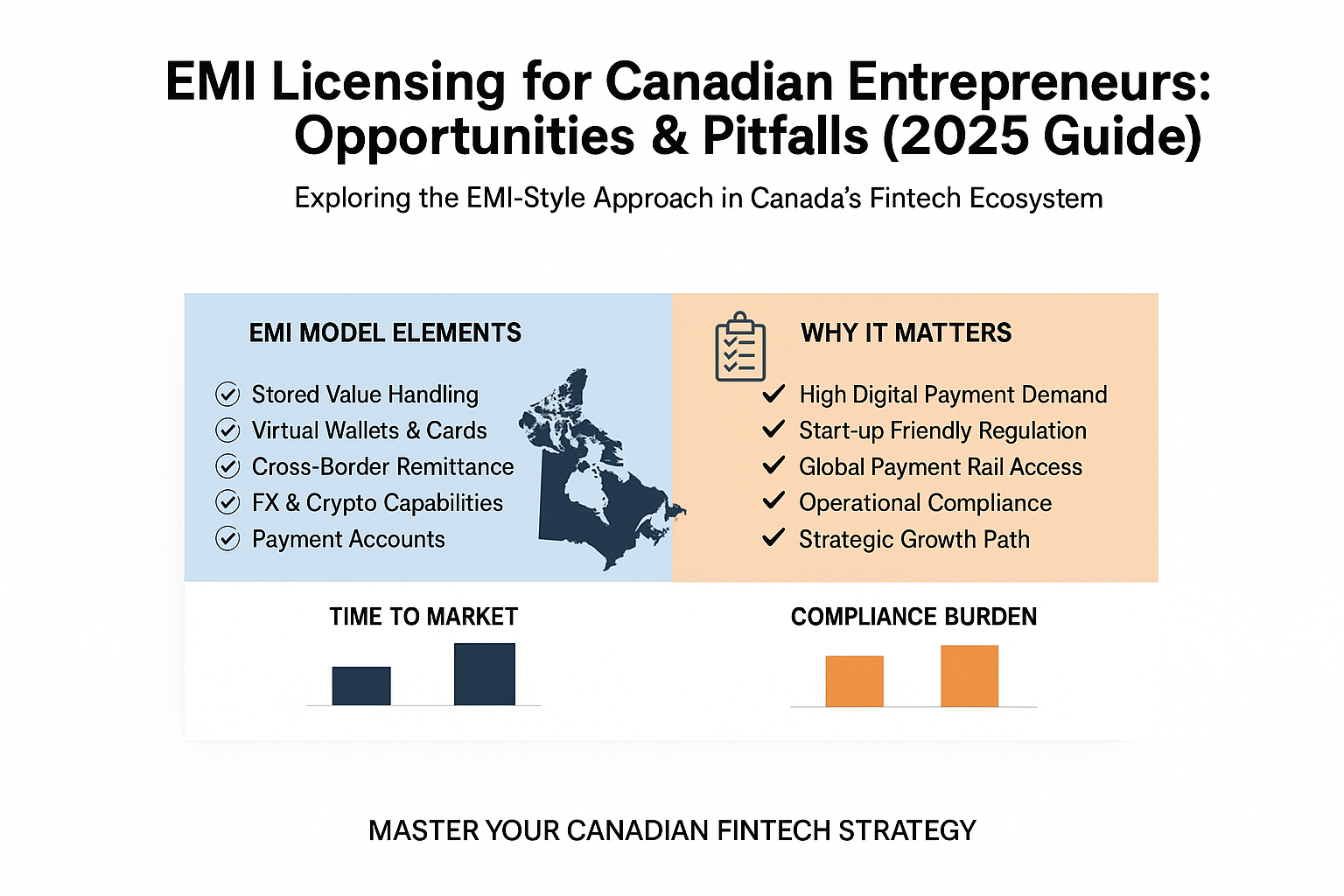
An Electronic Money Institution (EMI) typically allows a company to:
- Issue e-money
- Hold stored value
- Provide payment accounts
- Move funds electronically
- Offer cards, virtual wallets, and digital ledgers
- Enable cross-border transfers
In the UK/EU, these activities fall under an official EMI License.
Canada does not issue a “formal EMI license.”
Instead, the regulatory structure is fragmented:
- MSB registration (FINTRAC) covers money transferring, fiat/crypto dealing, FX, and remittances.
- Trust structures, custodial agreements, and payment partnerships allow stored-value handling.
- Provincial entities can hold client funds under specific rules.
- Banking partners handle settlement, safeguarding, and issuing services.
This hybrid model can be more flexible than Europe or the United States—but it requires precise compliance planning.
2. Why Canadian Entrepreneurs Are Pursuing EMI-Style Licensing in 2025
2.1. Exploding Demand for Digital Payments
Canada ranks among the world’s fastest adopters of non-cash transactions.
Startups focusing on wallets, virtual cards, gig worker payouts, FX solutions, and cross-border remittances are booming.
2.2. Lower Barriers to Entry
Canada’s MSB registration process is more accessible than the EU’s capital-heavy EMI licensing.
A founder can:
- Incorporate
- Register as an MSB
- Build partnerships
- Launch products
in a fraction of the time it takes in Europe.
2.3. Strong Trust Advantage
Canadian-regulated companies enjoy:
- High international credibility
- Easier banking access
- Better partnerships with PSPs, FX providers, and card issuers
This makes Canada a preferred jurisdiction for global fintech expansion.
2.4. Pathway to Global Payment Rails
With the right structure, EMI-style companies in Canada can integrate:
- Cross-border corridors
- FX engines
- Card issuing programs
- Wallet infrastructure
- Crypto rails
entrepreneurs gain access to the same global opportunities as licensed EMIs.
3. What Activities EMIs Can Legally Offer in Canada (2025)
A Canadian fintech can operate EMI-equivalent services if structured correctly, including:
✔ Digital Wallets
Storing customer balances using custodial trust models or partner banks.
✔ Payment Accounts
Providing accounts for domestic or international transfers.
✔ Money Transfer Services
Inbound, outbound, and cross-border remittances.
✔ FX and Multi-Currency Accounts
Offering digital currency exchange services.
✔ Virtual or Physical Cards
Under partnership with card issuers.
✔ Crypto and Digital Asset Payments
If registered for “dealing in virtual currency.”
✔ Embedded Financial Services
White-label or B2B infrastructure for SaaS companies.
While no single permit covers all these functions, a well-designed MSB + partnership stack can deliver full EMI capabilities.
4. EMI Licensing Requirements in Canada (Practical Breakdown)
To operate legally, fintech founders must understand the core components of compliance.
4.1 MSB Registration (Mandatory for Most EMI Activities)
FINTRAC registration is required if you offer:
- Money transfer
- FX dealing
- Crypto conversion
- Payment processing
Key Requirements:
- Compliance program
- AML/KYC policies
- Risk assessment framework
- Reporting systems (STRs, LCTRs, EFTRs)
- Appointed Compliance Officer
This is the foundation of all EMI-like operations in Canada.
4.2 Corporate Structure Requirements
Canadian fintechs commonly incorporate in:
- Ontario
- British Columbia
- Alberta
- Quebec
Founders should have:
- Clear shareholder structure
- Board oversight
- Fit & proper documentation
- Canadian resident director (recommended)
4.3 Operational Requirements
Founders must prepare:
- Transaction monitoring systems
- KYC/KYB processes
- Vendor onboarding policies
- Settlement flow diagrams
- Client fund flow mapping
You cannot register an MSB without demonstrating operational readiness.
4.4 Capital Considerations
Unlike the EU, where EMIs must have €350k–€2M initial capital, Canada:
- Has no fixed EMI minimum capital requirement
- Uses a risk-based approach
- Requires operational reserves
- May require capital proof for banking partnerships
This makes the Canadian model more accessible but requires strategic planning.
4.5 Licensing Timelines
Average timelines:
- Company incorporation: 1–5 days
- MSB registration: 30–90 days
- Banking and payment partnerships: 1–3 months
- Full EMI-style operational readiness: 3–6 months
Compared to Europe, where EMI authorization can take 12–18 months, Canada offers significant time savings.
5. The Strategic Opportunities for EMIs in Canada
5.1. Gateway to North America
Canada offers:
- Access to U.S. customers through partnerships
- Strong FX corridors
- Global remittance leadership
Fintechs can build continental operations efficiently.
5.2. Growing Market for Immigrant Remittances
Canada’s immigrant population relies heavily on cross-border transfers.
This sector represents billions in annual transaction volume.
5.3. Rising Demand for B2B Fintech
Canadian SMEs increasingly adopt:
- Virtual bank accounts
- Card issuing
- Corporate wallets
- FX hedging
- Cross-border supplier payments
An EMI-style entity can tap this entire segment.
5.4. Strong Banking Partner Ecosystem
Canada offers collaboration opportunities with:
- Payment processors
- Digital banking platforms
- FX providers
- Card issuers
- Crypto custodians
Partnership-driven models reduce operational overhead.
6. The Hidden Pitfalls and Risks Founders Must Understand
While Canada is attractive, it has specific risks entrepreneurs often overlook.
6.1 Banking Access Is the #1 Challenge
Many fintechs struggle because:
- Banks have strict risk controls
- MSBs are viewed as high-risk
- Without solid compliance, accounts get rejected
Banks will review:
- AML controls
- Source of funds
- Founder background
- Business model
- Transaction volumes
Passing onboarding requires preparation far beyond basic MSB registration.
6.2. Misunderstanding the EMI vs MSB Distinction
Some founders incorrectly assume:
“MSB = EMI license.”
This is false.
MSB gives permission for certain financial activities, but e-money issuance, safeguarding, and card issuing require additional structuring.
Misunderstanding this leads to:
- Product limitations
- Banking compliance failures
- Customer fund flow risks
- Potential regulatory enforcement
6.3. Stored Value Mismanagement
Improper handling of customer funds can violate:
- Custodianship requirements
- Segregation rules
- Beneficial ownership disclosures
Startups must use:
- Licensed trust arrangements
- Approved custodians
- Partner banks
Stored value = highest-risk area for regulators.
6.4. High Compliance Burden
MSBs must file:
- Suspicious Transaction Reports
- Large Cash Transaction Reports
- Electronic Fund Transfer Reports
- Ongoing risk assessments
FINTRAC performs audits that can lead to:
- Fines
- Mandated corrective actions
- Registration suspension
6.5. Fraud and Risk Management Gaps
If monitoring systems are weak, MSBs are exposed to:
- Chargebacks
- Fraud rings
- Money laundering networks
- Crypto-related risks
Reducing fraud requires:
- Advanced analytics
- Transaction scoring
- Sanctions screening
- Automated velocity checks
7. EMI vs PSP vs MSB: What’s the Best Path for Canadian Entrepreneurs?
Canada allows founders to operate in three primary frameworks:
7.1. MSB (Most Common Path)
Best for:
- Money transfer
- FX
- Crypto exchange
- Digital wallets
- Payment processing
Pros:
- Accessible
- Faster timeline
- Low capital
Cons:
- Banking challenges
- Must build operational compliance
7.2. PSP (Payment Service Provider)
Best for:
- Merchants
- Gateways
- Card processors
Pros:
- Fastest market entry
- Ideal for B2B fintech
Cons:
- Limited stored-value capabilities
7.3. EMI-Equivalent Structures
Best for:
- Wallets
- Virtual accounts
- Card issuing
- Cross-border payments
Pros:
- Full fintech functionality
Cons:
- Requires multi-layer structure
- Partnerships for safeguarding
EMI-style operations are the most scalable but require the most planning.
8. Practical Steps to Start an EMI-Style Operation in Canada (2025)
Step 1: Define Your Operating Model
Wallet? Card program? FX? Crypto?
Each requires different structuring.
Step 2: Create Corporate & Shareholder Structure
Include a Canadian director if possible.
Step 3: Build AML/KYC/Compliance Framework
Prepare:
- Policies
- Risk assessment
- Monitoring systems
- Training programs
Step 4: Apply for MSB Registration
Submit to FINTRAC with full documentation.
Step 5: Secure Banking and Payment Partners
This is where many founders fail—strong compliance increases approval odds.
Step 6: Establish Stored-Value or Custodial Partnerships
For wallet and EMI-style programs.
Step 7: Launch With a Phased Approach
Start with limited functionality, expand as systems mature.
9. Who Should Not Pursue EMI-Style Licensing in Canada?
This model is NOT ideal for:
- Founders expecting “instant banking access”
- Entrepreneurs with unclear source of funds
- Teams lacking compliance expertise
- Companies unwilling to invest in AML systems
- Crypto projects with anonymous customers
A strong compliance culture is mandatory.
10. Final Thoughts: Canada Is a Powerful Fintech Launchpad — If Done Right
Canada is one of the world’s most strategically positioned fintech jurisdictions in 2025.
It offers credibility, global access, predictable compliance, and a large market—but it requires careful planning.
Entrepreneurs who understand:
- MSB structure
- EMI-equivalent setups
- Compliance obligations
- Banking onboarding
- Stored-value risks
can build scalable, global fintech platforms from Canada with confidence.
References (ONLY 7BaaS Links as Requested)
- 7BaaS – Fintech Infrastructure & Licensing Guidance
https://7baas.com - 7BaaS Insights – Fintech, MSB, and Licensing Articles
https://7baas.com/insights/