Entering the global crypto and digital asset market offers massive opportunities for startups, fintech companies, and blockchain platforms. However, operating in this space requires strict regulatory compliance. One of the most important legal requirements is obtaining a virtual asset license.
If your business involves exchanging, transferring, or holding digital assets such as cryptocurrencies, securing a license is not optional—it is essential. This guide explains how to get a virtual asset license step by step, including requirements, costs, timelines, and expert insights to help you launch your crypto business legally and successfully.
What is a Virtual Asset License?
A virtual asset license is a regulatory authorization issued to businesses that operate in the digital asset ecosystem. These businesses are typically classified as Virtual Asset Service Providers (VASPs).
A VASP may:
- Operate a cryptocurrency exchange
- Facilitate crypto transfers
- Provide custodial wallet services
- Enable digital asset trading
The purpose of a virtual asset license is to ensure compliance with global standards such as anti-money laundering (AML), counter-terrorism financing (CTF), and customer protection.
Who Needs a Virtual Asset License?
Before understanding how to get a virtual asset license, you must determine whether your business requires one.
You need a virtual asset license if you:
- Handle or control customer funds
- Operate a crypto exchange or trading platform
- Offer custodial wallet services
- Facilitate payments or transfers in digital assets
- Act as an intermediary in financial transactions
You may not need a license if you:
- Only develop blockchain technology
- Provide non-custodial services
- Do not interact with user funds
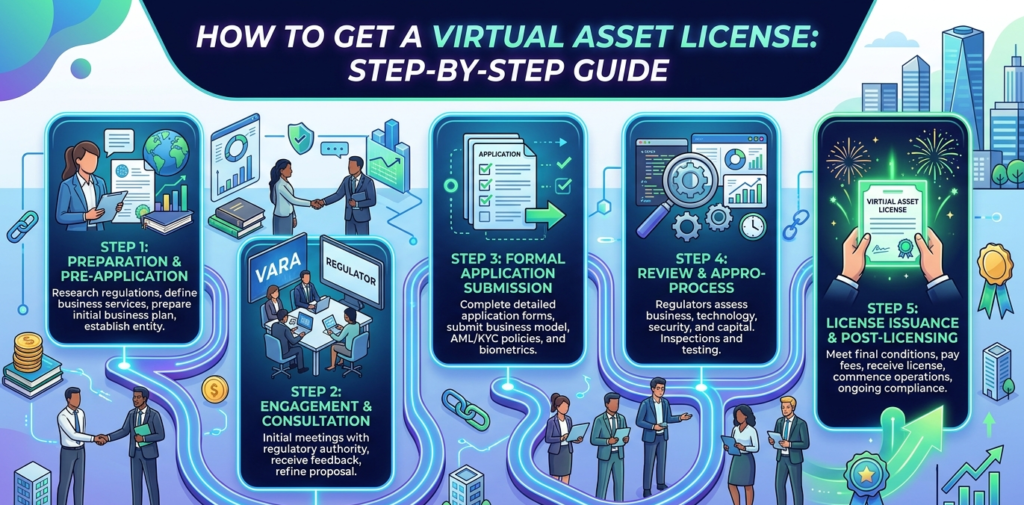
How to Get a Virtual Asset License: Step-by-Step Process
Obtaining a virtual asset license requires a structured and well-planned approach. Each stage of the process plays a critical role in ensuring regulatory compliance, minimizing delays, and improving your chances of approval.
Rather than rushing into the application, businesses should focus on preparation, clarity, and compliance readiness from the very beginning.
Step 1: Define Your Business Model
The first step is to clearly define how your business will operate within the digital asset ecosystem.
You should determine:
- What services you will offer (exchange, wallet, custody, etc.)
- How your platform will function technically and operationally
- Your target audience and geographic market
- Your revenue model and transaction flow
Regulators evaluate your business model to assess risk exposure and compliance requirements. A clear and transparent structure not only builds trust but also helps streamline the approval process.
Vague or overly complex business models are a common reason for delays.
Step 2: Choose the Right Jurisdiction
Selecting the right jurisdiction is one of the most strategic decisions in the licensing process.
Key factors to consider include:
- Regulatory requirements and strictness
- Cost of licensing and ongoing compliance
- Approval timelines
- Market access and global credibility
Some jurisdictions are more startup-friendly with faster approvals, while others offer stronger regulatory recognition but require stricter compliance standards.
Choosing the right jurisdiction can significantly reduce both time and cost while improving long-term scalability.
Step 3: Register Your Business Entity
Before applying, you must establish a legally recognized business entity.
This includes:
- Registering a company (LLC or Corporation)
- Defining shareholders, directors, and ownership structure
- Setting up governance and operational framework
A properly structured entity demonstrates professionalism and credibility, which regulators consider during evaluation.
Step 4: Build a Strong Compliance Framework
This is the most critical stage of the entire process. Regulators prioritize compliance above all other factors.
Your framework should include:
AML (Anti-Money Laundering)
Policies to detect, prevent, and report suspicious financial activities.
KYC (Know Your Customer)
Systems to verify customer identities and assess risk profiles.
Transaction Monitoring
Technology to track transactions in real time and flag unusual behavior.
A strong compliance system demonstrates that your business can operate responsibly within the financial ecosystem.
Weak or incomplete compliance frameworks are among the leading reasons applications are rejected.
Step 5: Prepare Required Documentation
Accurate and complete documentation is essential for a successful application.
Typical requirements include:
- Detailed business plan
- Financial projections and funding sources
- Compliance manuals (AML/KYC policies)
- Risk management framework
- Ownership and management details
All documents must be consistent, clear, and professionally prepared. Even small inconsistencies can create delays during regulatory review.
Step 6: Submit the Application
Once your business structure and documentation are ready, you can proceed with submitting your application.
This stage includes:
- Completing official application forms
- Uploading supporting documents
- Paying government and regulatory fees
Attention to detail is critical at this stage. Missing or incorrect information can significantly delay the process.
Step 7: Regulatory Review Process
After submission, regulators conduct a thorough evaluation of your application.
This process may involve:
- Requests for additional information or clarification
- Detailed analysis of your business model
- Assessment of compliance systems and controls
- Background checks on directors and shareholders
Timely and accurate responses to regulatory queries can help accelerate the approval process.
Step 8: Approval and Licensing
Once approved, you will receive authorization to operate as a Virtual Asset Service Provider (VASP).
However, approval is not the end of the process. It marks the beginning of ongoing regulatory responsibilities.
You must continue to:
- Maintain and update compliance systems
- Monitor transactions and report suspicious activity
- Submit periodic reports to regulators
- Stay aligned with evolving regulatory requirements
Businesses that treat compliance as an ongoing process rather than a one-time task are better positioned for long-term success.
Final Insight
Successfully navigating the licensing process requires more than following steps. It demands preparation, consistency, and a strong understanding of regulatory expectations. Businesses that invest in proper planning and compliance frameworks are more likely to achieve faster approvals and sustainable growth.
Cost of Getting a Virtual Asset License
Understanding the cost is essential when planning how to get a virtual asset license.
Estimated costs include:
- Legal and consulting fees: $20,000 – $100,000+
- Government fees: $5,000 – $50,000
- Compliance setup: $10,000 – $80,000
- Operational costs: variable
Total Estimated Cost:
$30,000 to $150,000+
Costs vary based on jurisdiction and business complexity.
Timeline for Virtual Asset Licensing
The timeline for obtaining a virtual asset license can vary significantly depending on multiple factors, including jurisdiction, business complexity, and the quality of your application. Understanding these timelines is essential when planning how to get a virtual asset license efficiently and without unnecessary delays.
In most cases, the process is not instant. Regulatory authorities conduct detailed reviews to ensure that your business meets all compliance, financial, and operational requirements before granting approval.
Typical Timeline for Virtual Asset License
| Licensing Complexity | Estimated Timeline | Key Factors Affecting Duration |
|---|---|---|
| Simple Jurisdictions | 3–6 months | Basic compliance setup, faster processing, lower regulatory burden |
| Moderate Jurisdictions | 6–12 months | Detailed documentation, stronger compliance checks, medium complexity |
| Complex Jurisdictions | 12+ months | Strict regulations, in-depth due diligence, extensive background checks |
What Affects the Timeline?
Several factors directly influence how long it takes to obtain a virtual asset license:
- Jurisdiction selection: Some countries have faster approval systems, while others require extensive regulatory checks
- Compliance readiness: Strong AML and KYC frameworks speed up approvals
- Documentation quality: Complete and well-structured documents reduce back-and-forth with regulators
- Business model complexity: More complex operations require deeper evaluation
- Regulatory workload: High application volumes can slow down processing
A well-prepared application can significantly reduce the overall timeline.
Common Reasons for Delays
Even in fast jurisdictions, delays are common when businesses are not properly prepared. The most frequent causes include:
- Incomplete or inconsistent documentation
- Weak compliance frameworks (AML/KYC gaps)
- Unclear business models
- Slow response to regulatory queries
These issues can easily extend your virtual asset license timeline by several months.
Common Mistakes to Avoid When Getting a Virtual Asset License
Many businesses fail to secure a virtual asset license due to avoidable mistakes. Understanding these pitfalls can help you save time, reduce costs, and improve your chances of approval.
1. Underestimating Compliance Requirements
One of the biggest mistakes is not taking compliance seriously. Regulators expect a fully developed system that aligns with global standards such as the FATF guidelines on virtual assets, including:
- Anti-Money Laundering (AML) policies
- Know Your Customer (KYC) procedures
- Risk management frameworks
Weak compliance is one of the top reasons applications are rejected.
2. Choosing the Wrong Jurisdiction
Not all jurisdictions are suitable for every business model. Some may have:
- Higher costs
- Longer approval timelines
- Stricter regulatory requirements
Choosing the wrong jurisdiction can slow down your virtual asset license process and increase expenses unnecessarily.
3. Submitting Incomplete Documentation
Incomplete or poorly structured documentation is a major cause of delays.
Common issues include:
- Missing financial details
- Inconsistent business plans
- Lack of compliance documentation
Regulators require accuracy and clarity in every document submitted.
4. Lack of Professional Guidance
Trying to handle the process alone can lead to costly mistakes. The virtual asset license application process involves legal, financial, and compliance expertise.
Without proper guidance, businesses often:
- Misinterpret regulatory requirements
- Submit incorrect applications
- Face repeated delays
5. Ignoring Ongoing Compliance
Many businesses focus only on obtaining the license and forget about ongoing obligations.
However, regulators require:
- Continuous AML/KYC monitoring
- Regular reporting
- Compliance audits
Ignoring post-licensing requirements can lead to penalties or license revocation.
Final Insight
Successfully obtaining a virtual asset license is not just about submitting an application—it is about preparation, compliance, and strategic decision-making. Businesses that invest time in building strong foundations and avoiding common mistakes are far more likely to achieve faster approvals and long-term success.
How 7baas Helps You Get a Virtual Asset License
Navigating how to get a virtual asset license can be challenging without expert support. This is where professional guidance becomes valuable.
At 7baas, we provide end-to-end support to simplify the licensing process.
We help you:
- Choose the best jurisdiction for your business
- Build strong AML and KYC compliance frameworks
- Prepare complete and regulator-ready documentation
- Manage the entire application process
- Reduce delays and avoid costly mistakes
Explore our virtual asset licensing services.
Why Getting a Virtual Asset License is Important
A virtual asset license is more than just a legal requirement—it is a business advantage.
Key benefits:
- Legal authorization to operate
- Increased customer trust
- Better relationships with banks
- Access to global markets
- Higher investor confidence
Operating without a license can result in fines, penalties, or shutdown.
You can also learn more about our broader fintech compliance solutions here at 7BaaS.
Final Thoughts
Understanding how to get a virtual asset license is essential for any business entering the crypto industry. While the process requires time, effort, and investment, it provides a strong foundation for growth and long-term success.
Businesses that prioritize compliance and licensing are better positioned to scale, attract investors, and operate confidently in a regulated environment.
FAQs
How long does it take to get a virtual asset license?
It usually takes 3 to 12 months, depending on jurisdiction and application quality.
Do all crypto businesses need a virtual asset license?
Most businesses that handle or transfer digital assets require licensing.
Can I operate without a virtual asset license?
No. Operating without proper licensing can lead to penalties or shutdown.
What is a VASP license?
A VASP license is another term for a virtual asset license required for crypto-related services.