Entering the United States financial market presents a significant growth opportunity for fintech startups, cryptocurrency platforms, and digital payment service providers. However, success in this space requires strict adherence to regulatory frameworks. One of the most critical requirements is obtaining a Money Transmitter License US (MTL)—a mandatory authorization for businesses involved in transferring, receiving, holding, or processing customer funds.
If your business facilitates financial transactions in any form, securing a money transmitter license in the US is not optional—it is a legal requirement enforced at both federal and state levels. Failing to comply can lead to serious penalties, operational restrictions, and loss of banking access. This comprehensive guide provides a step-by-step breakdown of how to get a Money Transmitter License US, including licensing requirements, costs, timelines, and proven strategies to help fintech businesses achieve compliance and scale successfully in the US market.
What is a Money Transmitter License US?
A Money Transmitter License US (MTL) is a state-issued regulatory authorization required for businesses that transmit money or monetary value from one party to another. It is a core legal requirement for companies operating in the financial services sector, particularly those involved in digital payments, remittances, and cryptocurrency transactions.
In the United States, financial regulators closely monitor how businesses handle customer funds. Any company that receives, holds, or transfers money on behalf of users is typically classified as a money transmitter and must obtain the appropriate licenses to operate legally.
The purpose is to ensure:
- Consumer protection
- Prevention of fraud and financial crimes
- Compliance with anti-money laundering (AML) regulations
- Transparency in financial transactions
Without proper licensing, businesses risk severe penalties, including fines, shutdowns, and loss of banking relationships.
Who Needs a Money Transmitter License?
Determining whether your business requires a Money Transmitter License US is one of the most important first steps. Regulatory definitions are broad, and many fintech startups underestimate their obligations.
You likely need an MTL if your business:
- Transfers funds between users or accounts
- Holds customer balances, wallets, or stored value
- Processes payments, remittances, or bill payments
- Operates a cryptocurrency exchange, wallet, or trading platform
- Facilitates peer-to-peer (P2P) payments
- Enables cross-border money transfers
- Acts as an intermediary in financial transactions
Examples of businesses that require MTL:
- Payment gateways and processors
- Mobile wallet applications
- Remittance and transfer platforms
- Crypto and Web3 financial services
- Digital banking and neobank platforms
When you may NOT need an MTL:
- If you only provide software or infrastructure without handling funds
- If a licensed financial institution directly manages all transactions
- If you operate under a regulated partner using a sponsorship model
However, these exceptions depend heavily on your business model. Regulators focus on what your platform actually does, not how it is marketed.
Simple rule:
If your platform touches, controls, or moves customer funds at any stage, you are likely required to obtain a money transmitter license in the US.
Understanding the US Licensing Structure
One of the most misunderstood aspects of obtaining a Money Transmitter License US is the fragmented regulatory structure. Unlike many countries, the United States does not offer a single, unified license for money transmission.
There is no single nationwide money transmitter license
Instead, businesses must comply with a dual regulatory framework, which includes both federal and state-level requirements.
Federal Level: MSB Registration
At the federal level, businesses must register as a Money Services Business (MSB).
Key points about MSB registration:
- Required for all money transmitters operating in the US
- Managed by the Financial Crimes Enforcement Network (FinCEN)
- Focuses on anti-money laundering (AML) compliance
- Must be renewed every two years
MSB registration ensures that your business is recognized at the federal level and complies with national financial crime prevention laws. However, it is important to understand that:
MSB registration is not a substitute for a Money Transmitter License US.
State Level: Money Transmitter License (MTL)
In addition to federal registration, businesses must obtain state-level money transmitter licenses in every state where they operate or serve customers.
Key characteristics of state licensing:
- Each state has its own regulatory authority
- Requirements, fees, and timelines vary by state
- Separate applications must be submitted for each state
- Compliance obligations differ across jurisdictions
What this means in practice:
If your business operates nationwide, you may need:
- 10+ licenses for regional operations
- 20–30 licenses for broader expansion
- 40+ licenses for full US coverage
This makes the money transmitter license US process complex, time-consuming, and resource-intensive.
Why the Dual Licensing Structure Matters
The combination of federal and state requirements creates a layered compliance system designed to protect consumers and maintain financial stability.
Key implications:
- You must meet both federal and state obligations simultaneously
- Approval in one state does not grant permission in another
- Compliance must be maintained continuously across all jurisdictions
Strategic insight:
Many successful fintech companies do not start with nationwide licensing. Instead, they:
- Launch in a limited number of states
- Build compliance infrastructure gradually
- Expand as the business grows
Summary: How US Money Transmitter Licensing Works
To legally operate as a money transmitter in the United States, your business must:
- Register as an MSB at the federal level
- Obtain a Money Transmitter License in each state of operation
- Build and maintain a strong compliance framework
- Continuously meet regulatory and reporting obligations
This multi-layered system may seem complex, but it is essential for building a legally compliant and scalable financial business in the US.
Step-by-Step Process
Obtaining a Money Transmitter License US (MTL) is a detailed, multi-stage process that requires legal preparation, financial strength, and strict compliance systems. Below is a fully optimized, step-by-step breakdown designed to help fintech startups, crypto platforms, and payment companies navigate the process efficiently.
Step 1: Determine if You Need a Money Transmitter License US
Before investing time and resources, you must clearly assess whether your business model requires an MTL.
You need a Money Transmitter License US if you:
- Handle, receive, or control customer funds
- Act as an intermediary in financial transactions
- Facilitate money transfers, payments, or remittances
- Operate digital wallets or crypto-related services
You may NOT need an MTL if you:
- Only provide software or technical infrastructure
- Partner with a fully licensed financial institution
- Do not directly interact with customer funds
However, relying on assumptions is risky. Regulatory authorities evaluate your actual operations, not your business description. Misclassification can lead to penalties, fines, or forced shutdowns.
Step 2: Establish Your US Business Entity
To apply for a money transmitter license in the US, you must first create a legally registered business entity.
Key requirements:
- Form a Limited Liability Company (LLC) or Corporation
- Obtain an Employer Identification Number (EIN)
- Define ownership, directors, and management structure
A properly structured entity enhances credibility, simplifies regulatory approval, and is essential for opening US bank accounts.
Step 3: Register as an MSB with FinCEN
At the federal level, you are required to register as a Money Services Business (MSB).
Important details:
- Mandatory for all money transmitters
- Managed by FinCEN (Financial Crimes Enforcement Network)
- Must be renewed every two years
- Supports AML (Anti-Money Laundering) compliance
You can register through the official FinCEN website.
Important: MSB registration does not replace a Money Transmitter License US. Both are required.
Step 4: Build a Strong Compliance Framework
This is the most critical stage of the entire money transmitter license US process. Regulators prioritize compliance above everything else.
Your compliance framework must include:
AML Program (Anti-Money Laundering)
- Risk-based internal policies
- Suspicious activity monitoring
- Reporting obligations
KYC Procedures (Know Your Customer)
- Customer identity verification
- Onboarding checks and documentation
Transaction Monitoring Systems
- Real-time tracking of transactions
- Fraud detection mechanisms
- Automated alerts
Compliance Officer
- A dedicated, qualified individual
- Responsible for overseeing regulatory compliance
A weak or generic compliance setup is one of the top reasons applications get rejected. Strong systems = faster approvals.
Step 5: Meet Financial Requirements
Financial capability is a core requirement for obtaining a License .
Key financial components:
Surety Bond
- Typically ranges from $25,000 to $1,000,000+
- Protects customers against financial loss
- Amount varies by state
Minimum Net Worth
- Defined by each state regulator
- Demonstrates financial stability
Financial Statements
- Audited reports
- Proof of liquidity and operational funding
This step ensures your business can responsibly manage customer funds and financial risk.
Step 6: Choose the States for Licensing
Since there is no nationwide license, you must decide where to apply.
Common starting states:
- California
- Texas
- Florida
- Delaware
Smart strategy:
- Start with a limited number of states
- Avoid highly complex jurisdictions initially
- Expand gradually as your business scales
Each state has different costs, documentation, and approval timelines, so strategic selection is key.
Step 7: Apply via NMLS
Most states process applications through the Nationwide Multistate Licensing System (NMLS).
Required documentation includes:
Business Plan
- Services offered
- Revenue model
- Operational workflow
Compliance Policies
- AML and KYC frameworks
- Risk management procedures
Financial Documents
- Balance sheets
- Income statements
Ownership Details
- Directors and shareholders
- Organizational structure
Background Checks
- Criminal history
- Financial credibility
Accuracy, transparency, and detail are essential for successful approval.
Step 8: Regulatory Review Process
After submission, regulators conduct a thorough review of your application.
What to expect:
- Requests for additional information
- Clarifications about your business model
- Verification of compliance systems
What regulators evaluate:
- Transparency and honesty
- Risk management capability
- Operational readiness
Quick, clear responses significantly improve approval speed.
Step 9: Approval Timeline
The timeline for obtaining a money transmitter license in the US varies by state and application quality.
Typical timelines:
- 3–6 months for simpler states
- 6–12 months for moderate states
- 12+ months for complex jurisdictions
Delays are usually caused by incomplete documentation, weak compliance frameworks, or slow responses.
Step 10: License Approval and Business Operations
Once approved, your business can legally operate as a money transmitter in that state.
Key benefits:
- Full legal protection
- Increased trust and credibility
- Easier access to banking partners
- Stronger investor confidence
Operating without a valid Money Transmitter License US can result in severe penalties, including fines and shutdowns.
Step 11: Ongoing Compliance Requirements
Obtaining the license is not the end — maintaining it is equally important.
Ongoing obligations:
- Annual license renewals
- Financial reporting and disclosures
- AML audits and compliance checks
- Regulatory inspections
Failure to maintain compliance can lead to license suspension or revocation.
Cost of Money Transmitter License US
The cost of obtaining a Money Transmitter License US can be substantial, especially for multi-state operations.
Estimated costs:
- Legal & consulting fees: $50,000 – $200,000+
- State application fees: $5,000 – $50,000 per state
- Surety bonds: $25,000 – $1,000,000+
- Compliance system setup: $20,000 – $100,000
Total estimated cost:
For businesses operating across multiple states, total costs can exceed $500,000 to $1 million+.
MTL vs MSB Registration (Key Differences)
Understanding the difference between MSB registration and a Money Transmitter License US is essential for compliance.
| Feature | MSB Registration | MTL License |
|---|---|---|
| Level | Federal | State |
| Purpose | Registration | Full license |
| Complexity | Low | High |
| Requirement | Mandatory | Mandatory |
Both are required to legally operate a money transmission business in the United States.
Final Insight
Getting a Money Transmitter License US is not just about meeting requirements—it’s about building a compliant, scalable, and trustworthy financial business.
If you want to simplify the process and avoid costly mistakes, working with experts can make a significant difference. You can explore professional support here at 7BaaS
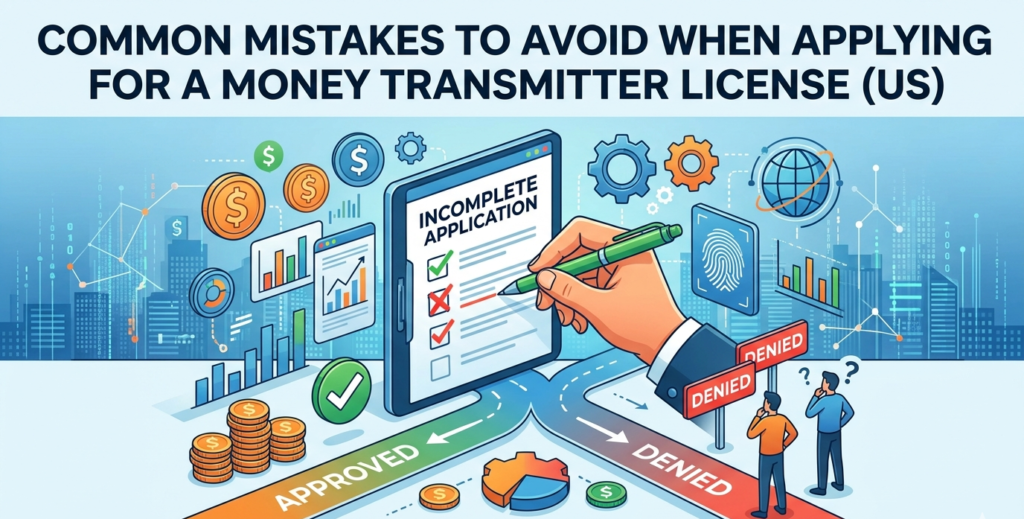
Common Mistakes to Avoid When Applying for a Money Transmitter License US
Avoiding critical mistakes can save your business time, money, and regulatory trouble during the Money Transmitter License US process.
Underestimating Costs
Many startups fail because they miscalculate the true cost of obtaining a money transmitter license in the US.
- Licensing is not just application fees
- Legal, compliance, and operational costs add up quickly
- Multi-state expansion significantly increases expenses
A realistic financial plan is essential before starting the process.
Weak Compliance Systems in Money Transmitter License US Applications
Regulators expect robust and fully functional compliance frameworks.
- Generic AML/KYC policies are often rejected
- Lack of transaction monitoring systems raises red flags
- Poor documentation delays approvals
A strong compliance system is the backbone of a successful application.
Applying to Too Many States
Trying to obtain licenses in multiple states at once can overwhelm your resources.
- Each state has different requirements
- Costs multiply rapidly
- Compliance becomes harder to manage
A smarter approach is to start small and scale gradually.
Ignoring Expert Guidance
The money transmitter license US process is complex and highly regulated.
- DIY approaches often lead to rejection
- Misinterpretation of regulations is common
- Errors can delay approvals by months
Working with experienced professionals can significantly improve success rates.
Alternatives to Full Money Transmitter License US
If obtaining a full Money Transmitter License US seems overwhelming at the early stage, there are strategic alternatives.
Banking-as-a-Service (BaaS) as an Alternative
- Partner with licensed financial institutions
- Use their infrastructure to operate legally
- Reduce compliance burden initially
Sponsorship Models Instead of Money Transmitter License US
- Operate under an existing licensed entity
- Faster market entry
- Lower upfront costs
Phased Expansion Strategy
- Start with a few states
- Build compliance systems gradually
- Expand as your business grows
This approach reduces risk while maintaining scalability.
Expert Support from 7BaaS
Navigating the Money Transmitter License US process requires precision, expertise, and strategic planning.
Working with professionals helps you:
- Avoid costly mistakes
- Accelerate approval timelines
- Build a strong compliance foundation
If you need assistance, explore our specialized money transmitter license US services.
You can also learn more about our fintech and compliance solutions here at 7BaaS.
Why Compliance Matters More Than Ever in Money Transmitter License US
Regulatory scrutiny in the United States is increasing, especially with the rapid growth of fintech and crypto businesses.
A properly structured Money Transmitter License US and compliance system gives you a major competitive advantage.
Businesses with strong compliance:
- Gain trust from banks and financial partners
- Attract investors more easily
- Scale faster without regulatory barriers
Businesses without compliance:
- Face fines and legal penalties
- Lose access to banking services
- Risk shutdown before growth
Compliance is no longer optional—it is a long-term business strategy.
Final Thoughts
Obtaining a Money Transmitter License US is a complex but essential step for any business handling financial transactions in the United States.
It requires:
- Careful planning
- Significant financial investment
- A strong compliance framework
While the process can feel overwhelming, the long-term benefits are substantial:
- Legal protection
- Access to the US financial market
- Scalable business growth
Frequently Asked Questions (FAQs)
How long does it take to get a Money Transmitter License US?
The timeline typically ranges from 6 to 18 months, depending on the states selected and the quality of your application.
Do crypto businesses need a Money Transmitter License US?
Yes, in most cases. If your platform transfers or holds user funds, you will likely require a money transmitter license in the US.
Can I operate without a Money Transmitter License US?
No. Operating without proper licensing can result in:
- Heavy fines
- Legal action
- Business shutdown
Is there a nationwide Money Transmitter License US?
No. There is no single nationwide license. Businesses must obtain state-level licenses in each jurisdiction where they operate.