
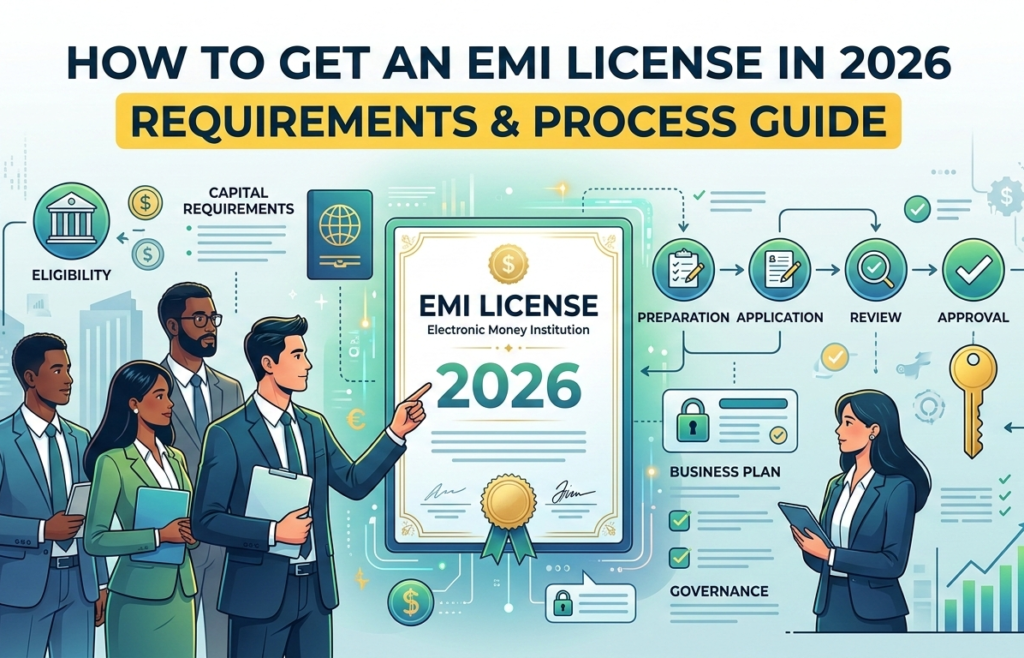
The global fintech ecosystem is expanding rapidly. Today, digital wallets, prepaid card programs, cross-border remittances, and multi-currency platforms are transforming how money moves worldwide. However, as innovation grows, regulatory oversight has become stricter. Therefore, fintech companies must secure proper authorization before operating payment or e-money services.
If your business plans to issue electronic money or safeguard customer funds, understanding how to get an EMI license is essential. Without an Electronic Money Institution (EMI) license, operating in regulated markets such as the United Kingdom or the European Union can expose your company to serious legal and financial risks.
In addition, obtaining an EMI license does more than ensure compliance. It strengthens credibility, builds investor confidence, improves banking relationships, and enables structured cross-border expansion.
In this guide, you will learn:
- What an EMI license is
- Who requires an Electronic Money Institution license
- Key EMI license requirements in 2026
- The complete EMI license application process
- Estimated EMI license cost breakdown
- UK vs EU EMI licensing differences
- Ongoing compliance obligations after approval
What Is an EMI License and Why Is It Important?
An Electronic Money Institution (EMI) license is a regulatory authorization that permits a company to issue electronic money and provide specific payment services.
Electronic money refers to digitally stored monetary value that can be used to execute payment transactions.
What an EMI License Allows a Fintech Company to Do
With an EMI license, a company can:
- Issue electronic money (e-money)
- Provide digital wallet services
- Process online and mobile payments
- Facilitate domestic and international transfers
- Offer prepaid cards
- Safeguard customer funds
In the UK, EMI licensing is regulated by the Financial Conduct Authority (FCA)
Within the European Union, EMI licensing operates under EU directives supervised by national regulators.
An EMI license provides legal credibility, investor confidence, and access to regulated financial markets.
Who Needs an EMI License?
Before learning how to get an EMI license, it is essential to determine whether your business model requires one.
Business Activities That Require EMI Licensing
You typically need an EMI license if your fintech company:
- Issues stored digital value
- Holds client funds electronically
- Operates digital wallet infrastructure
- Provides regulated payment execution services
- Issues prepaid instruments
- Enables cross-border electronic transfers
Examples of Businesses Requiring an EMI License
Common business models include:
- Digital banking platforms
- Remittance providers
- Multi-currency fintech apps
- Payment service aggregators
- E-wallet operators
If your company issues electronic value rather than acting purely as a technical service provider, EMI licensing is usually mandatory.
EMI License Requirements in 2026
Understanding EMI license requirements is central to successfully learning how to get an EMI license.
Regulators evaluate financial strength, operational maturity, compliance systems, and governance structures.
Capital Requirements for an EMI License
Applicants must demonstrate sufficient initial capital and maintain ongoing capital adequacy.
There are generally two types of EMI authorization:
Small EMI License
- Lower capital threshold
- Limited transaction volume
- Restricted operational scope
Authorized EMI License
- Higher capital requirement
- Broader service permissions
- Increased regulatory scrutiny
Capital must remain available at all times and is subject to periodic review.
AML and Regulatory Compliance Requirements
A robust Anti-Money Laundering (AML) and Know Your Customer (KYC) framework is mandatory for authorization. Regulators expect institutions to demonstrate that financial crime risks are properly identified, monitored, and controlled from the outset.
A strong compliance structure typically includes:
- Formal AML policy documentation
- Clear customer due diligence procedures
- Defined risk assessment methodology
- Ongoing transaction monitoring systems
- Suspicious activity reporting mechanisms
These controls must align with international standards issued by the Financial Action Task Force (FATF). Regulators carefully assess whether compliance procedures are tailored to the specific business model rather than copied from generic templates.
Weak or incomplete compliance frameworks remain one of the most common reasons applications are delayed or rejected.
Safeguarding Requirements
Protecting customer funds is a core regulatory obligation and a central component of approval.
Institutions must safeguard client funds through one of the following methods:
- Segregated safeguarding accounts held with authorized credit institutions
- Approved insurance policies or comparable guarantee arrangements
Regulators require detailed explanations of how safeguarding operates in practice.
Applications should clearly outline:
- Daily safeguarding calculations
- Reconciliation procedures
- Fund segregation controls
- Insolvency protection arrangements
Insufficient detail in safeguarding documentation frequently results in follow-up queries and extended review timelines.
Business Plan and Financial Forecasts
A comprehensive and well-structured business plan is essential. Regulators use it to evaluate operational readiness and long-term sustainability.
A complete submission should include:
- Clear description of services
- Defined revenue model
- Target market analysis
- Organizational structure
- Risk mitigation strategy
- Three-year financial projections
Forecasts must be realistic and supported by defensible assumptions. Overly optimistic projections can reduce regulatory confidence.
Governance and Fit-and-Proper Assessment
Regulators evaluate directors and key shareholders under a “fit and proper” standard to ensure leadership integrity and competence.
The review typically considers:
- Relevant professional experience
- Regulatory and financial background
- Financial integrity
- Criminal record checks
Strong governance, transparent ownership structures, and experienced management significantly improve approval probability.
Step-by-Step Application Process
Understanding the application process in advance helps you prepare strategically and avoid unnecessary delays. Each stage builds on the previous one, so careful planning is essential.
Step 1: Define Your Business Model
Before applying, clearly outline how your fintech company will operate.
Ask yourself:
- Will you issue electronic money?
- Will you safeguard client funds?
- Will you operate across borders?
- Will you issue prepaid cards or digital wallets?
A clearly defined business model determines the correct licensing category and regulatory scope. Regulators expect your operational structure to be transparent, realistic, and aligned with compliance obligations.
Step 2: Choose the Right Jurisdiction
Jurisdiction selection is a strategic decision that directly impacts:
- Capital requirements
- Approval timelines
- Regulatory reputation
- Expansion flexibility
United Kingdom
- Regulated by the Financial Conduct Authority (FCA)
- Strong global credibility
- Independent regulatory framework post-Brexit
European Union
- Passporting rights across EU member states
- Supervised by national financial regulators
- Access to multiple markets under a single authorization
Choosing the right regulatory environment is critical for long-term scalability and international growth.
Step 3: Build Compliance Infrastructure Before Submission
Before submitting your application, your internal systems must be regulator-ready.
This includes establishing:
- AML and KYC procedures
- Safeguarding arrangements
- Internal compliance controls
- Risk management framework
- IT and cybersecurity protections
- Data protection policies
Incomplete infrastructure is one of the most common reasons for regulatory delays. Strong preparation significantly improves approval efficiency.
For structured preparation and documentation support, professional fintech licensing services are available at 7baas.
Step 4: Prepare and Submit Documentation
The application must include comprehensive and well-structured documentation.
Typical submissions include:
- Corporate formation documents
- Shareholder and director disclosures
- Compliance manuals
- Detailed business plan
- Financial forecasts
- Operational workflows
- Technology system overview
Thorough, clearly written documentation increases regulatory confidence and reduces follow-up queries.
Step 5: Regulatory Review and Clarifications
After submission, regulators conduct a detailed review.
During this phase, they may:
- Request additional information
- Conduct interviews with directors
- Require revisions to policies
- Examine safeguarding structures
- Assess financial assumptions
Timely and transparent communication is essential. Delays in responding to regulatory questions often extend the approval timeline.
Step 6: Ongoing Compliance After Approval
Receiving authorization is not the end of the process. Ongoing compliance obligations must be maintained.
License holders are required to:
- Submit periodic financial reports
- Maintain capital adequacy
- Conduct continuous AML monitoring
- Perform internal audits
- Update compliance policies as regulations evolve
Failure to meet ongoing regulatory requirements can result in penalties, restrictions, or even suspension of authorization.
EMI License Cost Breakdown
The EMI license cost varies depending on jurisdiction and business complexity.
Typical EMI License Cost Components
- Regulatory application fees
- Legal and advisory fees
- Compliance system implementation
- Required capital deposit
- Ongoing reporting expenses
Budget planning should begin before initiating the EMI license application process.
How Long Does It Take to Get an EMI License?
One of the most common questions fintech founders ask when researching how to get an EMI license is about the approval timeline. However, there is no single universal timeframe. Approval timelines vary depending on the regulator, jurisdiction, business model complexity, and — most importantly — the quality of your preparation.
Although regulators publish estimated processing periods, the actual EMI license approval timeline depends heavily on how complete and regulator-ready your application is at the time of submission.
In general, well-prepared applications move significantly faster than incomplete or poorly structured submissions.
Estimated EMI License Timeline by Jurisdiction
Below is a general comparison of typical approval timelines in major regulated markets:
| Jurisdiction | Estimated Approval Timeline | Regulatory Complexity | Key Influencing Factors |
|---|---|---|---|
| Certain EU Member States | 3–6 months | Moderate | Completeness of AML framework, safeguarding structure, capital adequacy |
| United Kingdom (FCA) | 6–12 months | High | Detailed compliance review, governance assessment, regulatory queries |
| Smaller EU Financial Hubs | 4–8 months | Moderate to High | Business model complexity, passporting intentions |
| Complex Multi-Structure Applications | 9–12+ months | Very High | Cross-border model, outsourcing arrangements, risk exposure |
These estimates assume that documentation is properly structured and compliance systems are already in place before submission.
Realistic Planning for EMI License Approval
When planning how to get an EMI license, it is prudent to assume:
- At least 6 months for structured preparation and review
- Up to 12 months for highly regulated jurisdictions such as the UK
Strategic preparation before submission is often the difference between a 6-month and 12-month approval cycle.
For companies seeking to optimize the EMI license application process, structured preparation and regulatory advisory can significantly improve timeline predictability.
You can review professional EMI license advisory services here at 7baas
EMI License vs Payment Institution License: Key Differences
Many fintech founders researching how to get an EMI license consider whether a Payment Institution (PI) license may be sufficient.
EMI License Allows
- Issuing electronic money
- Holding stored digital value
- Offering prepaid instruments
Payment Institution License Allows
- Executing payment transactions
- Merchant acquiring
- Payment processing
It does not permit issuing electronic money.
Selecting the correct license category is essential for long-term scalability.
Why Professional Support Improves EMI License Approval Rates
Although it is technically possible to apply independently, securing an Electronic Money Institution (EMI) license without expert guidance significantly increases the risk of delays, revisions, or rejection. The EMI license application process is highly detailed, and regulators expect precision, clarity, and regulatory maturity in every submission.
Therefore, structured advisory support plays a critical role in improving approval outcomes.
Professional support strengthens:
Jurisdiction Strategy for EMI Licensing
Choosing the right jurisdiction directly impacts capital requirements, approval timelines, regulatory burden, and long-term scalability. Expert advisors evaluate whether a UK EMI license or EU EMI license best aligns with your expansion goals, business model, and compliance capacity.
A well-planned jurisdiction strategy reduces unnecessary regulatory friction and accelerates market entry.
Regulatory Documentation Quality
One of the most common reasons EMI applications are delayed is incomplete or poorly structured documentation. Regulators carefully review business plans, AML frameworks, safeguarding explanations, financial forecasts, and governance structures.
Professional support ensures that your EMI license documentation:
- Aligns with regulator expectations
- Clearly reflects your operational model
- Addresses compliance risks proactively
- Demonstrates financial sustainability
High-quality documentation significantly improves regulatory confidence.
Compliance Framework Strength
Regulators assess whether your company can operate safely within a regulated environment. A strong AML and compliance framework is essential for EMI approval.
Specialized advisory helps structure:
- Risk assessment models
- Transaction monitoring systems
- Customer due diligence procedures
- Ongoing compliance oversight mechanisms
A mature compliance framework signals operational readiness and reduces regulatory concern.
Risk Mitigation and Safeguarding Planning
Safeguarding customer funds and managing operational risks are core EMI obligations. Structured advisory ensures your safeguarding methodology, reconciliation processes, and risk management controls are regulator-ready.
Proper risk planning not only supports approval but also protects your business long term.
Faster and More Predictable Approval Timelines
Because regulators may request clarifications or revisions, poorly prepared applications often face extended review periods. Professional guidance anticipates regulator questions in advance, which helps minimize back-and-forth communication.
As a result, the EMI license approval timeline becomes more predictable and efficient.
For companies building regulated fintech infrastructure, exploring specialized regulatory support reduces compliance risk, strengthens application quality, and increases the probability of successful EMI authorization.
You can review structured EMI license advisory services at 7baas
Conclusion: Building a Sustainable EMI-Licensed Fintech Business
Understanding how to get an EMI license requires strategic preparation, regulatory awareness, and structured compliance systems.
An EMI license provides:
- Legal authorization
- Market credibility
- Investor confidence
- Cross-border scalability
- Consumer trust
Fintech companies that approach EMI licensing methodically position themselves for sustainable growth in highly regulated financial markets.
For structured fintech licensing services and EMI regulatory advisory, visit 7baas
Frequently Asked Questions About How to Get an EMI License
What is an EMI license?
An EMI license allows fintech companies to issue electronic money and provide regulated payment services.
How long does it take to get an EMI license?
Typically between 3 and 12 months depending on jurisdiction and application completeness.
What are the key EMI license requirements?
Capital adequacy, AML compliance framework, safeguarding procedures, governance assessment, and financial projections.
Can startups apply for an EMI license?
Yes, provided regulatory capital and compliance standards are met.
Can an EMI license operate internationally?
EU EMI licenses may allow passporting across EU states. UK EMI licenses operate under UK jurisdiction.