
In the rapidly evolving financial landscape of 2026, traditional banks are no longer the sole controllers of payments, money storage, and financial transactions. Fintech companies, digital wallets, payment platforms, and embedded finance solutions now dominate the way businesses and individuals transfer, manage, and store money, creating both opportunities and regulatory challenges for new entrants. At the heart of this transformation lies the EMI License—short for Electronic Money Institution License—which allows non-bank companies to legally issue electronic money and provide fully regulated payment services. Obtaining an EMI License is more than a compliance requirement; it is a mark of credibility, operational maturity, and long-term business scalability.
This guide is designed to provide a complete overview of the EMI License, explaining what it is, why it is critical in 2026, who needs it, and the steps involved in obtaining and maintaining one. Readers will gain insights into the key regulatory requirements, governance standards, compliance frameworks, capital obligations, and operational considerations necessary to succeed in the highly regulated electronic money ecosystem. Whether you are a fintech startup, a digital wallet provider, or an established payment platform, this guide will help you understand the strategic value of holding an EMI License and provide actionable information for navigating the licensing process efficiently.
What Is an EMI License?
An EMI License is a regulatory authorization granted to companies that issue electronic money and provide payment services under strict financial supervision.
Electronic money (e-money) refers to digitally stored monetary value representing a claim on the issuer, used for making payment transactions. Examples include:
- Digital wallets
- Prepaid and virtual cards
- Online payment accounts
- Stored-value mobile applications
Unlike traditional banks, companies operating under an EMI License do not lend money or accept deposits. Instead, they must safeguard customer funds separately and make them available on demand.
In 2026, EMI-licensed institutions play a critical role in:
- Cross-border payments
- Embedded finance
- Neobanking platforms
- B2B payment infrastructure
- Marketplace and platform payments
For businesses seeking expert guidance on obtaining and maintaining an EMI License, platforms like 7BaaS provide professional support through their EMI Licensing Services.
Why the EMI License Is Essential in 2026
Global regulatory scrutiny has intensified. Authorities now demand transparency, strong governance, and consumer protection from all financial service providers. Holding an EMI License offers three major advantages:
1. Legal Authorization
Operating without proper licensing exposes businesses to fines, account closures, and criminal liability. An EMI License ensures full regulatory legitimacy.
2. Market Trust
Banks, card networks, investors, and enterprise clients prefer (and often require) licensed EMI partners.
3. Scalability
An EMI License enables structured expansion into new markets, products, and payment rails without rebuilding compliance frameworks from scratch.
For official regulatory guidance and best practices, companies often refer to resources from the European Central Bank, which provides comprehensive oversight frameworks for electronic money institutions.
EMI License vs Bank License: Key Differences
A common misconception is that an EMI License is nearly identical to a banking license. In reality, they serve very different purposes.
| Feature | EMI License | Bank License |
|---|---|---|
| Issue electronic money | ✅ Yes | ✅ Yes |
| Accept deposits | ❌ No | ✅ Yes |
| Provide loans | ❌ No | ✅ Yes |
| Safeguard customer funds | ✅ Mandatory | ✅ Mandatory |
| Regulatory burden | Medium | Very High |
| Time to obtain | 6–18 months | 2–5 years |
For fintech businesses focused on payments, wallets, and financial infrastructure, an EMI License provides flexibility without the extreme cost and complexity of full banking regulation.
What Activities Are Allowed Under an EMI License?
Holding this type of license allows companies to legally perform a variety of financial services, including:
- Issuing electronic money
- Opening and managing payment accounts
- Executing payment transactions
- Issuing debit, prepaid, or virtual cards
- Providing money remittance services
- Enabling merchant payments
- Supporting embedded finance solutions
However, institutions operating under this authorization cannot use customer funds for lending or investment purposes. All client money must be safeguarded in segregated accounts.
Who Needs This License?
Any business that holds or issues digital funds will generally need regulatory approval. Typical entities include:
- Fintech startups
- Digital wallet providers
- Neobanks and challenger banks
- Payment service providers
- Embedded finance platforms
- Marketplaces holding user balances
- Payroll and payout platforms
Even B2B platforms increasingly require this type of licensing as regulators strengthen oversight around stored-value models.
Requirements for Obtaining an EMI License in 2026
Regulators have significantly raised standards over recent years. Today, obtaining authorization to issue electronic money requires demonstrating operational maturity—not just having a good idea.
1. Minimum Capital Requirements
Most jurisdictions require initial capital ranging from €350,000 to €500,000, depending on location and business scope.
2. Strong Governance
Applicants must appoint:
- Qualified directors
- Experienced compliance officers
- Risk and AML specialists
Regulators assess both the qualifications and past regulatory track record of senior management.
3. Robust Compliance Framework
A successful application includes:
- AML and KYC policies
- Risk management procedures
- Fraud prevention systems
- Data protection and cybersecurity controls
4. Safeguarding Arrangements
Customer funds must be protected through segregated bank accounts or insurance mechanisms.
5. Clear Business Plan
Authorities expect a detailed, realistic plan showing:
- Revenue streams
- Target markets
- Operational processes
- Growth strategy
Timeline for Obtaining Authorization
In 2026, the approval process varies by jurisdiction but generally follows this pattern:
- Preparation phase: 2–4 months
- Regulatory review: 6–12 months
- Final approval: 1–3 months
On average, businesses should expect 9–18 months from initial planning to final approval. Delays often occur due to incomplete documentation, inexperienced management, or insufficient compliance frameworks.
Costs Associated with an EMI License
An EMI License is a long-term investment. Typical costs include:
- Regulatory capital
- Application and supervisory fees
- Legal and compliance consulting
- Ongoing audit and reporting costs
- AML monitoring tools and systems
While upfront costs are significant, many fintech companies choose licensing over reliance on third-party sponsors to gain independence and valuation growth.
For businesses exploring alternatives, some providers offer EMI-as-a-Service models, which can reduce time to market. Platforms offering embedded compliance and infrastructure—such as modular financial service providers—can support faster launches while preparing for full licensing later.
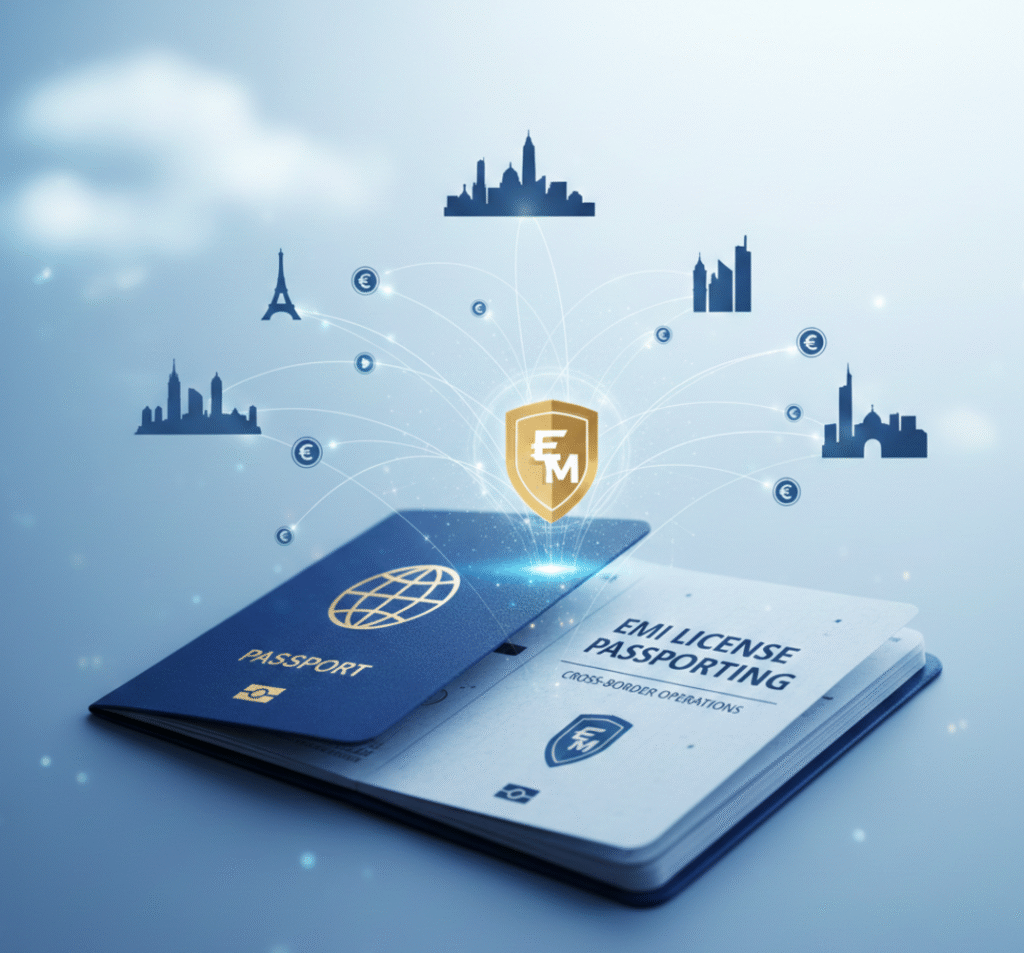
EMI License Passporting and Cross-Border Operations
In certain regions, an EMI License allows passporting, meaning licensed institutions can operate across multiple countries without reapplying for local licenses.
This is particularly valuable for:
- Pan-regional payment platforms
- Cross-border fintech services
- International e-commerce ecosystems
However, passporting rules depend on jurisdiction and ongoing regulatory alignment, making compliance management essential.
Regulatory Oversight and Ongoing Obligations Under an EMI License
Holding an EMI License is not a one-time regulatory milestone—it is an ongoing commitment to compliance, transparency, and operational discipline. In 2026, financial regulators have significantly strengthened their supervisory frameworks, placing Electronic Money Institutions under continuous monitoring.
Once an EMI License is granted, regulators expect institutions to maintain the same standards that justified approval in the first place. Failure to meet these expectations can lead to serious enforcement actions, including financial penalties, restrictions on operations, or complete license revocation.
Continuous Regulatory Supervision for EMI License Holders
Regulatory authorities actively supervise companies operating under an EMI License to ensure consumer protection and financial stability. This supervision includes both scheduled and ad-hoc reviews of operational, financial, and compliance activities.
Supervisors may request documentation, conduct inspections, or initiate thematic reviews focusing on areas such as anti-money laundering controls or safeguarding arrangements. EMI-licensed institutions must be prepared to demonstrate compliance at all times, not only during annual audits.
Financial Reporting Obligations Under an EMI License
One of the core responsibilities of an EMI License holder is regular financial reporting. Institutions are required to submit periodic reports that reflect their financial health and operational performance.
These reports typically include:
- Balance sheets and income statements
- Transaction volume and payment flow data
- Capital adequacy calculations
- Safeguarding account reconciliations
Accurate and timely reporting is critical. Inconsistent or delayed submissions often trigger enhanced regulatory scrutiny.
Transaction Monitoring and Risk Management for Compliance
Effective transaction monitoring is a central pillar of EMI License compliance in 2026. Regulators expect institutions to deploy automated systems capable of detecting suspicious or unusual activity in real time.
Key expectations include:
- Risk-based monitoring rules
- Customer behavior analysis
- Ongoing review of high-risk transactions
- Escalation and reporting mechanisms
An EMI License holder must be able to show that its monitoring framework evolves alongside transaction volumes and emerging financial crime risks.
AML Audits and KYC Controls
Anti-money laundering (AML) and know-your-customer (KYC) controls remain among the most scrutinized areas of license oversight.
Institutions must:
- Conduct regular internal and external AML audits
- Maintain updated customer due diligence procedures
- Monitor politically exposed persons (PEPs)
- File suspicious activity reports when required
In 2026, regulators place particular emphasis on ongoing customer monitoring, not just onboarding checks. Weak AML controls are one of the leading causes of EMI License enforcement actions.
Capital Adequacy Requirements Under an EMI License
Maintaining sufficient regulatory capital is a non-negotiable obligation for EMI License holders. Capital adequacy ensures that institutions can absorb operational losses and continue functioning without risking customer funds.
Regulators regularly assess:
- Minimum capital thresholds
- Capital buffers relative to transaction volume
- Liquidity management practices
Failure to meet capital requirements can result in operational restrictions or mandatory remediation plans.
Cybersecurity and Data Protection Obligations
As digital finance expands, cybersecurity has become a top regulatory priority. EMI License holders are expected to implement robust technical and organizational measures to protect customer data and payment systems.
Cybersecurity obligations typically include:
- Secure IT infrastructure and encryption protocols
- Incident response and breach notification procedures
- Regular penetration testing and system audits
- Compliance with data protection laws
Inadequate cybersecurity controls can expose institutions to both regulatory penalties and reputational damage.
Consequences of Non-Compliance With EMI License Requirements
Regulators possess wide enforcement powers when EMI License obligations are breached. Consequences may include:
- Monetary fines
- Increased supervisory monitoring
- Restrictions on business activities
- Temporary suspension of the EMI License
- Permanent license revocation
In severe cases, regulators may also take action against individual directors or senior management.
Regulatory Guidance for EMI License Holders
To remain compliant, EMI License holders frequently rely on guidance issued by central banks and financial supervisory authorities. These publications clarify expectations, interpret regulatory changes, and outline best practices for Electronic Money Institutions.
In Europe, guidance from supervisory bodies and institutions such as the European Central Bank plays a key role in shaping regulatory standards for EMI License holders and the broader electronic money ecosystem.
Common Challenges in Obtaining an EMI License
Although demand for electronic money institutions continues to rise, approval rates remain relatively low. Many applications fail not because the idea is weak, but because the business is not ready for regulatory scrutiny.
Financial regulators in 2026 expect applicants to demonstrate operational maturity, not just ambition. The following challenges are among the most common reasons for rejection or prolonged review.
Weak Compliance Structures
One of the biggest red flags for regulators is a poorly designed compliance framework. Many applicants rely on generic policies that are copied from templates and fail to reflect how the business will actually operate.
Authorities look for tailored procedures that clearly explain:
- How risks are identified and managed
- How customer activity is monitored
- How internal controls function in practice
If compliance exists only on paper, regulators will notice.
Underqualified Leadership and Management
Regulators closely assess the experience and competence of senior management. A strong product team alone is not enough.
Applications often fail when:
- Directors lack financial services experience
- Key roles are filled too late in the process
- Responsibilities are unclear or overlapping
Regulators want confidence that leadership understands regulatory obligations and can manage them effectively over time.
Unrealistic or Overambitious Business Models
Another common issue is a business plan that looks impressive but lacks realism. Overestimated revenues, vague target markets, or unclear monetization strategies raise serious concerns.
Authorities expect:
- Conservative financial projections
- Clear explanations of revenue sources
- Practical growth strategies
A grounded, well-reasoned plan is far more convincing than aggressive forecasts.
Poor AML Risk Assessment
Anti-money laundering controls are a major focus during the application review. Many applicants underestimate the level of detail required in their risk assessments.
Common mistakes include:
- Failing to identify high-risk customer segments
- Ignoring cross-border transaction risks
- Treating AML as a one-time checklist
Regulators expect a living framework that adapts as the business grows and evolves.
Insufficient Capital Planning
Capital is not just about meeting minimum thresholds. Regulators want proof that the business can remain stable under pressure.
Applications may be rejected when:
- Capital planning is short-term
- Liquidity risks are overlooked
- Contingency planning is missing
A clear view of how the company will remain financially resilient is essential.
Substance Over Speed in 2026
In 2026, regulators consistently prioritize substance over speed. Fast-tracked applications that lack depth are often delayed or rejected entirely.
Companies that treat licensing as a shortcut to market access usually struggle. Those that invest time in building real governance, compliance, and operational capacity stand a far better chance of success.
Is an EMI License Worth It in 2026?
The short answer is yes—provided your business is committed to long-term growth and regulatory compliance.
Holding an EMI License provides several strategic advantages:
- Direct control over payments: Manage transactions and customer funds without relying on third-party providers.
- Higher margins: Reduce dependency costs and optimize revenue streams.
- Stronger investor confidence: Licensed institutions are perceived as credible and low-risk.
- Long-term scalability: Expand products, services, and markets while remaining compliant.
- Regulatory independence: Operate with legal authority and flexibility in multiple jurisdictions.
For fintech companies focused on building sustainable financial infrastructure rather than short-term solutions, an EMI License is more than a regulatory requirement—it is a valuable asset that supports growth, trust, and operational resilience.
Final Thoughts on the EMI License
The EMI License has become a cornerstone of the modern financial ecosystem. In 2026, it represents more than regulatory approval—it signals maturity, trust, and readiness to operate at scale.
As digital finance continues to evolve, licensed Electronic Money Institutions will remain at the forefront of innovation, bridging the gap between traditional banking and next-generation financial services.
For businesses planning to enter or expand within regulated markets, understanding and securing an EMI License is not optional—it is essential. For professional support, explore 7BaaS EMI Licensing Services to navigate the process efficiently and ensure long-term compliance.
1. Can I start a fintech business without an EMI License?
You can operate certain payment-related services with third-party providers, but if you plan to issue electronic money or hold customer funds directly, an EMI License is mandatory. Operating without it can lead to fines, account freezes, or legal action.
2. What is the difference between an EMI License and a Payment Institution license?
While both allow regulated financial services, an EMI License specifically authorizes issuing electronic money and safeguarding client funds. A Payment Institution license typically focuses on payment processing without issuing e-money.
3. Do I need local presence to obtain an EMI License?
Requirements vary by jurisdiction. Some regulators require a local office and directors, while others allow remote operations with appointed local representatives. Checking the specific country regulations is crucial.
4. Are there ongoing technology requirements for license holders?
Yes. Regulators expect secure IT infrastructure, encryption protocols, and regular system audits. Strong cybersecurity measures are mandatory to protect customer funds and transaction data.
5. Can investors or partners require an EMI License for collaboration?
Absolutely. Many banks, payment processors, and enterprise clients prefer working with licensed entities to ensure regulatory compliance and risk management. Having the license can unlock partnership opportunities.
6. What happens if my business grows faster than expected under the license?
Regulators expect institutions to scale responsibly. You may need to increase capital, expand compliance staff, or upgrade risk monitoring systems. Failure to adjust can result in warnings or operational restrictions.