
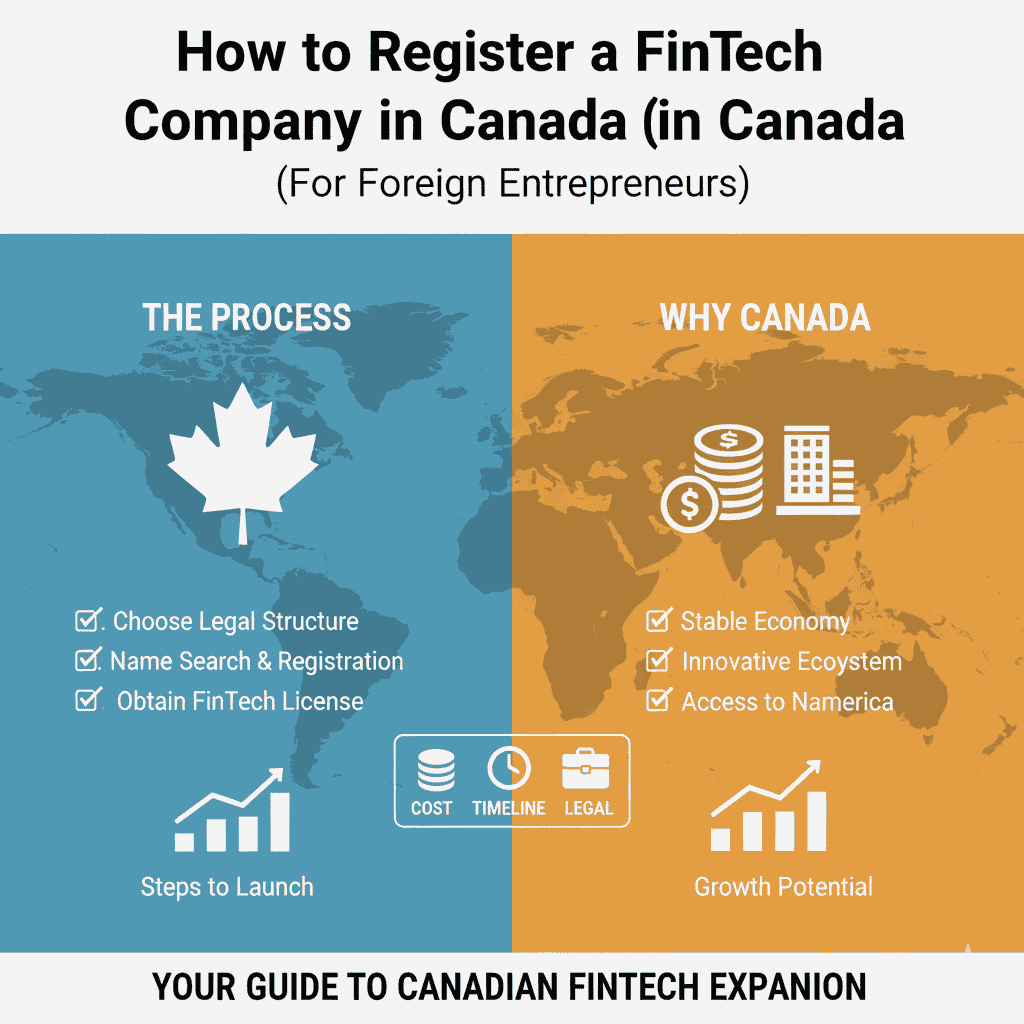
Canada’s stable economy and thriving tech landscape make it an attractive destination for foreign fintech entrepreneurs. Registering a fintech company in Canada lets founders tap into a robust financial ecosystem, government incentives, and a large pool of tech-savvy customers. This guide covers the step-by-step process to register a fintech company in Canada, key regulatory requirements, and best practices for non-Canadian founders.
Canada welcomes international startups, but foreign entrepreneurs must follow the country’s legal and immigration rules. Understanding Canadian business structures, incorporation steps, and compliance obligations is essential. This article explains what you need to know from choosing a corporate form and obtaining a Business Number to securing fintech licenses and meeting data protection laws. By the end, readers will know how to navigate company formation, licensing (like FINTRAC registration), tax registration, and other requirements. Whether you plan to operate remotely or immigrate, you’ll learn the essentials of launching a fintech in Canada, plus practical advice and resources to get started.
Why Canada Is Attractive for FinTech Entrepreneurs
Canada offers several advantages for fintech startups, such as a stable economy, strong rule of law, and progressive financial sector reforms. The country ranks high in innovation indexes and has a well-educated, multilingual workforce. Government programs and grants (e.g., for tech innovation) are available to new businesses. Notably, Canada’s large immigrant population (about half of new residents in 2022 were young tech-savvy professionals) means a built-in market for modern digital financial services. In short, foreign founders can benefit from supportive policies and a mature market, making Canada a strategic base for scaling global fintech solutions.
- High regulatory standards: Canada’s financial sector is tightly regulated, which can build credibility for your fintech. Compliance with rules (e.g., Anti‑Money Laundering via FINTRAC, or consumer protection laws) is required, but it also means Canadian customers and partners trust licensed providers.
- Access to funding: Canadian fintechs have access to both venture capital and government R&D incentives (like the SR&ED tax credit). Foreign founders can tap into this capital pool and programs once registered.
- Entrepreneurial ecosystem: Major cities like Toronto, Vancouver, and Montreal have active startup communities, incubators, and fintech associations (e.g., Fintechs Canada) that foster innovation and partnerships with banks.
With the above in mind, the first concrete step is choosing the right business structure and jurisdiction for incorporation in Canada.
Choosing the Right Business Structure
Foreign entrepreneurs must decide on a legal structure for their fintech. The main options are:
- Corporation: A separate legal entity registered with federal or provincial authorities. Corporations offer limited liability (the owners’ personal assets are protected) and are generally favored by fintechs seeking investment. (As one expert notes, “A corporation in Canada is a distinct legal entity… providing limited liability protection”.) Corporations must file annual returns and pay corporate taxes on profits.
- Partnership: Two or more persons share ownership. Partners report their share of income on personal tax returns. Partnerships are simpler than corporations but carry personal liability for all partners. A partnership agreement is recommended to outline roles and profit-sharing.
- Sole proprietorship: One individual owns the business and reports income on their personal taxes. It’s the simplest setup but the owner is personally liable for debts. This structure is best for very small operations or testing a new idea; however, most fintech startups choose incorporation for liability protection.
For fintech startups, incorporating as a Canadian corporation is usually optimal. It allows you to raise capital, bring on shareholders, and separate personal assets from the business. You can incorporate either federally or provincially:
- Federal incorporation (Canada-wide): Register with Corporations Canada to operate in all provinces. Federal incorporation provides name protection nationwide and often bundles key registrations. In fact, “when you incorporate federally, you get many of the other registrations you need at the same time” – including your Articles of Incorporation, a federal business number, and initial CRA tax accounts. However, federal law (the Canada Business Corporations Act) requires that at least 25% of directors be Canadian residents (or at least one if fewer than four directors are named). Foreign founders can still use federal corp but often need a local director or partner unless choosing provinces without such requirements.
- Provincial incorporation: You can also incorporate in a specific province (for example, Ontario or British Columbia). Provincial incorporation is typically faster and cheaper if your fintech will operate mostly in one region. Notably, Ontario and British Columbia allow 100% foreign ownership with no Canadian-resident director required, making them very accessible for international founders starting from abroad. (Other provinces like Quebec, Alberta, etc., have their own rules.)
Key Considerations:
- Federal vs Provincial: If you plan to expand across Canada or want stronger name protection, federal incorporation is worth considering. If your operations will be limited to one province, local incorporation can reduce costs and bureaucracy.
- Director Requirements: Check residency rules. As noted, Ontario and BC allow fully foreign boards. If incorporating federally or in provinces with restrictions, you’ll need at least one Canadian director. This is a common reason foreign founders partner with Canadian residents or use nominee directors.
- Business Name: Whichever path you choose, pick a unique name. For federal incorporation, you must obtain a NUANS report to ensure your name isn’t already taken. Provincial registries have similar name search processes. If branding is important, consider registering a trademark with the Canadian Intellectual Property Office to protect your fintech’s name and logo.
Steps to Register a FinTech Company in Canada
The process of actually registering involves several clear steps. Below is an overview of the essential tasks (in order) to launch your fintech entity in Canada.
- Decide on Business Structure and Jurisdiction. Choose whether to incorporate, form a partnership, or operate as a sole proprietor. (Most fintech startups choose incorporation for liability and investment reasons.) If incorporating, decide federal vs provincial and ensure compliance with any residency rules. Consider using 7BaaS’s Company Formation Services to expedite this choice and handle paperwork.
- Choose a Company Name and Conduct a Name Search. Select a unique corporate name that meets Canadian rules (e.g. containing “Inc.” or “Corp.”). Federal incorporation requires a NUANS name search report (a credit bureau check for name availability). Provincial incorporations may require similar searches. Reserve the name if needed.
- File Articles of Incorporation. Prepare and submit the incorporation documents to the appropriate authority (Corporations Canada for federal, or the provincial business registry). This typically includes:
- Articles of Incorporation (company name, address, share structure, etc.),
- List of directors (with proof of identity),
- Application forms specific to the jurisdiction.
Paid fees apply (federal fees vary by number of shareholders; provinces may charge lower fees). In your articles, clearly define share classes, director powers, and any special conditions (for example, financing rights or founder agreements).
- Articles of Incorporation (company name, address, share structure, etc.),
- Obtain a Canadian Business Number (BN) and Tax Accounts. Once incorporated, register with the Canada Revenue Agency (CRA) to get a federal Business Number – a unique 9-digit identifier for your company. The BN is used for all tax and government accounts. Under this BN, set up accounts for:
- Corporate Income Tax (CB designation) – required for all corporations.
- GST/HST – if your worldwide taxable sales exceed CAD $30,000 in a calendar year, you must register to collect GST/HST. (Below that threshold, registration is optional but recommended for input tax credits.)
- Payroll Deductions (RP for income tax withholdings, CPP, and EI) – if you plan to hire employees.
- Other Federal Taxes – such as import/export (RM account) if you will import goods or collect sales tax in harmonized provinces.
7BaaS can assist with these filings as part of its Company Formation and MSB Registration services.
- Corporate Income Tax (CB designation) – required for all corporations.
- Open a Canadian Business Bank Account. To properly manage finances, open a corporate bank account in Canada. Most major Canadian banks (e.g. RBC, TD, CIBC) will require that at least one director or officer visit a branch in person with identification and the incorporation documents. Make sure to bring the Certificate of Incorporation, articles, and Business Number confirmation. Having a Canadian bank account helps separate personal and company funds (important for liability and tax) and is usually needed to receive payments from local clients or partners.
- Obtain Necessary Licenses and Permits. Depending on your fintech’s services, you may need specific regulatory licenses (see next section). For example:
- Register as a Money Services Business (MSB) with FINTRAC if you handle currency exchange, international money transfers, payments, or virtual currencies.
- Comply with securities regulations if you plan to offer investment or crowdfunding platforms.
- Follow provincial consumer protection laws if your services touch on lending or insurance.
7BaaS’s MSB Registration Services and Fintech Licensing Expertise can guide you through these requirements.
- Register as a Money Services Business (MSB) with FINTRAC if you handle currency exchange, international money transfers, payments, or virtual currencies.
Each of these steps may involve detailed documentation (e.g., proof of identity for directors, descriptions of business activities, compliance programs). Planning ahead and possibly working with consultants (such as 7BaaS) can streamline the process.
Regulatory and Licensing Requirements for Fintechs
Registering the company is just the start. Fintech firms in Canada must comply with financial regulations and licensing. Key requirements include:
- MSB Registration (FINTRAC): If your fintech provides payment services, transfers funds, exchanges currency (including crypto), or issues/remits payment products, you must register as a Money Services Business with FINTRAC before commencing operations. This applies to both Canadian and foreign-owned MSBs. FINTRAC registration is free but requires submitting details of your company, owners, and compliance program. Once registered, you must implement an AML/ATF (Anti-Money Laundering/Anti-Terrorist Financing) compliance program, report large/suspicious transactions, and maintain client records. (In essence, MSB registration is mandatory for fintechs dealing with funds.)
- Other Financial Licenses: If your fintech involves investment services (e.g. robo-advisors, trading platforms, crowdfunding), you may need to register with securities regulators. Canada’s provinces have their own securities commissions (often working together as the Canadian Securities Administrators, CSA). For example, dealers or advisers must register, and crowdfunding portals require a specific exemption registration. The process varies by province, but engaging a securities law expert is prudent.
- Banking Licenses: Only federally chartered banks (regulated by OSFI) or credit unions can take deposits. If you plan to offer banking-like services (e.g. loans or accounts), you must obtain an OSFI license or partner with a bank. For many fintech startups, partnering or acting as a neobank via a bank partner is simpler than obtaining a full bank charter.
- Payment Network Rules: If dealing with credit/debit cards, you must follow PCI-DSS data security standards and get approved by card schemes (Visa, Mastercard). If using the Canadian Payments Association (now Payments Canada) rails, ensure any required membership or connections.
- Data Privacy (PIPEDA): Fintechs handle sensitive personal and financial data. Canadian law requires protecting customer data under the Personal Information Protection and Electronic Documents Act (PIPEDA). Implement appropriate data security, privacy policies, and consent mechanisms. PIPEDA compliance is a cornerstone trust factor for customers.
- Provincial Requirements: Beyond federal rules, check for provincial licenses or registrations (e.g., provincial money transmitter licenses in Quebec, or registration with a provincial consumer agency).
Compliance can be complex, so many fintech founders work with specialized consultants. For example, 7BaaS offers Fintech Licensing & Compliance services to help fintechs navigate FINTRAC, CSA, and other regulatory processes.
Tax Registration and Ongoing Obligations
After registering and opening an account, ensure you meet Canada’s tax obligations:
- Corporate Taxes: Canadian corporations pay federal and provincial income taxes on profits. Rates vary by province but are generally moderate (federal ~15% plus provincial). Ensure timely filing of T2 returns each year.
- GST/HST: If your sales exceed $30,000 in four consecutive quarters, you must collect GST/HST on Canadian sales. Register for a GST/HST account (if not done in Step 4). Provinces like Ontario and British Columbia have harmonized sales tax (HST in ON, GST + PST in BC), so know which rate applies to your products/services.
- Payroll Remittances: If you hire employees in Canada, you must withhold income tax, Canada Pension Plan (CPP), and Employment Insurance (EI) premiums, and remit them regularly. Also, file annual reports (T4 slips).
- Annual Corporate Filings: Maintain corporate records (minutes, resolutions). Federal corporations must file an annual return with Corporations Canada and update any changes (like new directors). Provincial companies have similar annual reports.
- Reporting and Accounting: Keep detailed financial records. Canada’s rules require accounting for all transactions, especially for auditing and tax audit purposes. Many foreign startups engage local accounting firms to ensure compliance and to apply for any available R&D credits or grants.
Failing to register for taxes or pay them is a serious offense. The Canada Revenue Agency (CRA) has tools to enforce compliance (e.g. penalties, interest). In short, register all required tax accounts early and set up good bookkeeping.
Key Considerations for Foreign Entrepreneurs
- Residency and Work Permits: Registering a company doesn’t automatically grant the right to work in Canada. If you plan to move and run the business locally, you may need a visa or work permit. Canada’s Start‑up Visa program targets innovative foreign entrepreneurs; it requires backing from a designated organization. Otherwise, you can own and run a Canadian company remotely, but have a local representative.
- Canadian Director: If your corporation’s law (federal or certain provinces) requires a resident director and you lack one, consider appointing a trusted Canadian as a director. Alternatively, incorporate in Ontario or British Columbia, which allow 100% foreign directors.
- Virtual Office: Many foreign startups use a virtual office or a Canadian agent address for official correspondence. These services provide a mailing address and telephone answering in Canada, which is often needed for official registration.
- Banking Logistics: As mentioned, plan how you’ll manage banking and payments. Some banks offer specialized fintech accounts, but most require an in-person visit. If founders cannot visit Canada immediately, consider travel plans or setting up with a local partner.
- Professional Assistance: Incorporation and compliance can be daunting from abroad. Experts like 7BaaS can handle many steps remotely. For example, 7BaaS offers Company Formation Services to handle paperwork, and Compliance Consulting to help maintain licenses and reporting in Canada.
By following these steps and ensuring full compliance, foreign entrepreneurs can successfully register and operate a fintech business in Canada. Expert guidance (like 7BaaS’s specialized services) can greatly simplify the process.
Conclusion
Registering a fintech company in Canada as a foreign entrepreneur is entirely possible with the right preparation. Canada’s welcoming business environment, robust legal framework, and strong fintech ecosystem provide fertile ground for innovative financial startups. By carefully choosing a corporate structure, completing the incorporation steps, and meeting all licensing and tax requirements, founders can establish a solid footing in the Canadian market.
In summary, the key steps are: incorporate (federally or provincially) with a unique name, register for a Business Number and tax accounts (including GST/HST if required), open a business bank account, and secure any needed fintech licenses (e.g. FINTRAC MSB registration). Throughout, ensure compliance with Canadian laws (data privacy under PIPEDA, securities rules, AML regulations, etc.).
Foreign entrepreneurs should also consider immigration programs (like the Start-up Visa) if planning to live in Canada. Ultimately, partnering with knowledgeable advisors can save time and avoid pitfalls. For expert assistance, reach out to 7BaaS’s corporate services team – our Company Formation and MSB Registration experts can guide you through every step of launching your compliant Canadian fintech. Begin your journey today and tap into Canada’s dynamic fintech ecosystem!