
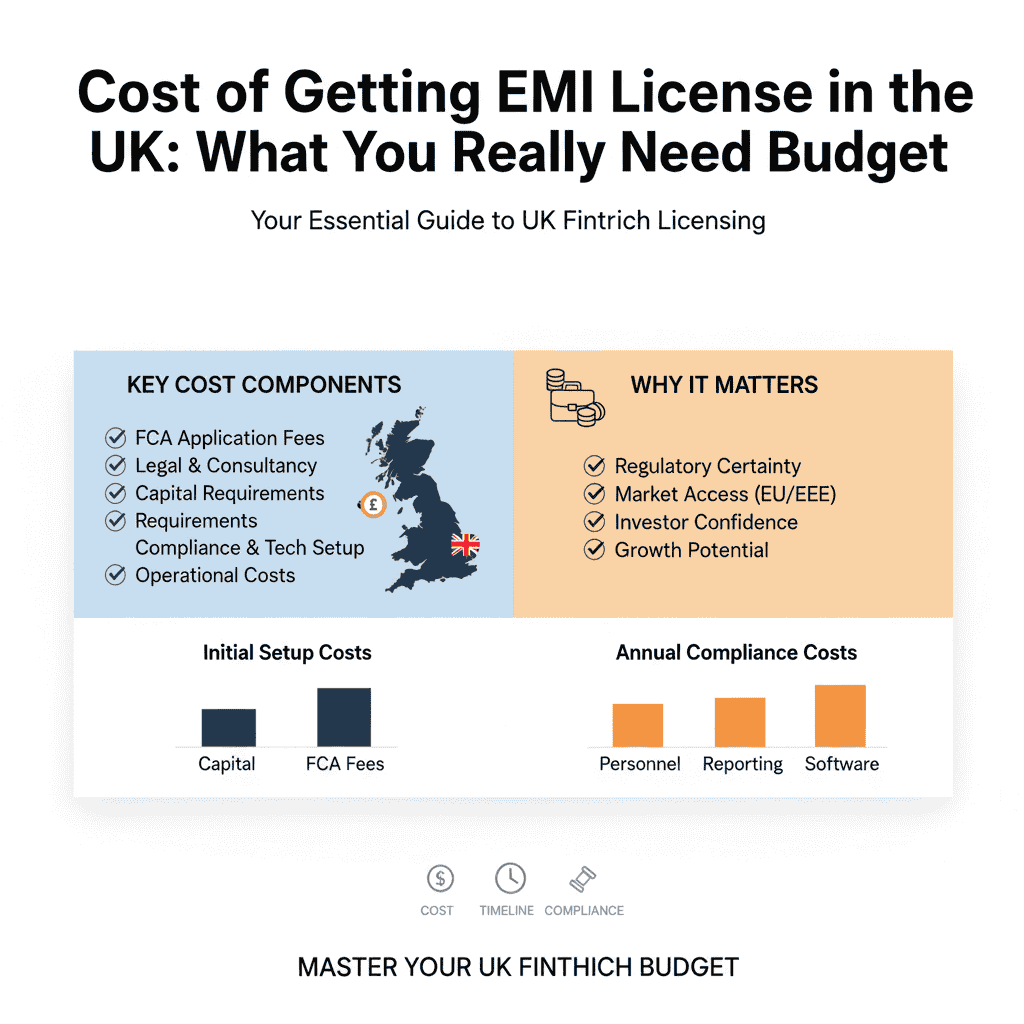
The United Kingdom remains one of the most attractive jurisdictions for fintech entrepreneurs. With London at the heart of global finance, the UK’s Electronic Money Institution (EMI) license is widely recognised as a mark of credibility and regulatory strength.
At first glance, the official requirements to obtain an EMI license may appear straightforward — a government fee and a capital requirement. However, the reality is more complex. The true cost of securing and maintaining an EMI license goes far beyond published figures. For first-time applicants and seasoned fintech professionals alike, understanding these hidden costs is essential to building a sustainable business plan.
This article explores both the official and the ‘real’ costs of obtaining an EMI license in the UK. It breaks down the expenses across licensing, legal support, banking, compliance staffing, and technology — giving you a complete picture of what to expect.
Official Costs: The Entry Ticket
The FCA (Financial Conduct Authority) has made the application process clear and transparent, and the costs to apply are relatively modest compared to the overall investment required.
– FCA Application Fee:
– £5,000 for Small EMI[1]
– £25,000 for Full EMI
– Initial Capital Requirement (under EU EMR 2011):
– €350,000 for Full EMI[2]
– €20,000–50,000 for Small EMI
On paper, this looks manageable. Yet, these numbers only cover the regulator’s side of the equation. In practice, they are dwarfed by the costs of compliance, operations, and banking.
Advisory & Legal Support
Preparing an EMI application without professional help is virtually impossible. The FCA expects to see comprehensive policies, governance structures, and risk frameworks.
– Application drafting & compliance advisory: £60,000–150,000[2]
– Policy documentation (AML, safeguarding, risk, governance): £20,000–50,000
– Corporate structuring & setup costs: £10,000–25,000
In total, legal and advisory support typically amounts to £100,000–200,000.
Banking & Safeguarding Accounts
Perhaps the most challenging part of the EMI journey is banking access. Every EMI must safeguard client funds in segregated accounts with reputable banks. These accounts not only ensure consumer protection but also provide operational credibility.
– Onboarding fees: £5,000–15,000
– Monthly safeguarding account charges: £5,000–20,000+
– Annual safeguarding cost: £60,000–250,000
In many cases, banks demand additional assurances, such as higher capital deposits or enhanced compliance monitoring, further increasing costs.
Compliance & Staffing
The FCA places significant emphasis on experienced leadership and independent compliance oversight. This means that your EMI must employ qualified personnel locally in the UK.
– Local Directors & Board Members: FCA expects strong governance with financial services experience.
– Compliance Officer / MLRO: £80,000–120,000 per year.
– Internal Auditor / Risk Manager: £20,000–50,000[2] per year.
Together, staffing often costs £200,000–300,000[5] annually. For most applicants, this is the single largest recurring expense.
Technology & Infrastructure
Running an EMI is not just about having the license — it requires robust systems to manage client funds, process payments, and monitor risk.
– Core banking or ledger system: £50,000–100,000 setup.
– Transaction monitoring & AML software: £20,000–50,000[2] setup + £2,000–5,000 monthly.
– Card issuing and payment integrations: £30,000–80,000.
Overall, expect £100,000–250,000 in upfront tech costs, with ongoing operational expenses in the tens of thousands annually.
The Whisper: The Real Cost
Regulators often highlight only the official fees and capital requirements. But entrepreneurs quickly discover that the true costs lie elsewhere.
– Government Fees: £25,000
– Capital Requirement: €350,000 (must be blocked as regulatory capital).
– Legal, banking, compliance, and tech costs: £400,000–700,000.
Realistic Year-One Budget: £750,000–1,200,000.
This figure reflects what it actually takes to not only obtain the license but also survive the first 12 months of operations. The whisper in the industry is simple: if you don’t have at least £1 million set aside, your EMI project is underfunded.
Why It’s Worth the Investment
Despite the high cost, the EMI license offers:
– Credibility: Recognition from one of the world’s strictest regulators.
– Market Access: Ability to issue e-money and offer payment accounts across the UK.
– Scalability: Strong investor confidence and higher valuations compared to unregulated entities.
For serious fintech ventures, the EMI license is not a cost — it is an investment in long-term growth and trust.
Conclusion
The UK EMI license is one of the most respected non-bank licenses worldwide. But while the official costs are only a few thousand pounds, the true budget extends into the hundreds of thousands.
Entrepreneurs should plan for at least £750,000–1,200,000 in year-one expenses to cover legal support, safeguarding accounts, compliance staff, and technology. With the right preparation, this investment pays dividends by opening doors to new markets, attracting investors, and building lasting credibility.
Bottom line: don’t be misled by the headline fees. Budget realistically — and you’ll position your EMI project for success.
Visuals: Cost Breakdown
The chart below illustrates a breakdown of typical EMI licensing costs in the UK.

Visuals: Year-One Budget
The following chart highlights the realistic year-one budget required to operate as an EMI in the UK.

FAQs
1. How much does it cost to get an EMI license in the UK in 2025?
The total cost of obtaining an EMI license in the UK typically ranges from £750,000 to £1.2 million for the first year. This includes FCA fees (£25,000), capital requirements (€350,000), and expenses for legal, banking, compliance, and technology setup.
2. What are the official FCA fees for an EMI license?
The FCA application fee is £5,000 for a Small EMI and £25,000 for a Full EMI license. However, these fees represent only a fraction of the total cost — most of the expense lies in compliance, staffing, and operational setup.
3. What is the minimum capital requirement for a UK EMI?
Under EU EMR 2011, the minimum initial capital requirement is €350,000 for Full EMIs and €20,000–50,000 for Small EMIs. This capital must remain blocked as regulatory capital and cannot be used for operations.
4. Why are safeguarding accounts so expensive for EMIs?
Safeguarding accounts are mandatory under FCA rules to protect client funds. Banks charge high onboarding and maintenance fees (often £60,000–250,000 per year) due to compliance obligations and risk management requirements.
5. How long does it take to get an EMI license in the UK?
The timeline varies by case but usually takes 6–12 months from application to authorization. Most of the time is spent on preparing documentation, meeting FCA expectations, and completing due diligence.
6. Is obtaining an EMI license in the UK worth the investment?
Yes. Despite high costs, a UK EMI license provides global credibility, investor confidence, and access to the UK and EU payment markets. For serious fintech ventures, it’s a strategic investment in long-term growth and trust.
References
- FCA – Authorisation and registration application fees. Financial Conduct Authority. “E‑money institution (EMI)” fees. Available at: https://www.fca.org.uk/firms/authorisation/apply/fees
- Buckingham Capital Consulting. “Authorised EMI UK — How much is the FCA fee for an EMI licence application in the UK?” Available at: https://www.buckinghamcapitalconsulting.com/authorised-emi-uk
- FintechXpndr. “Electronic Money Institution (EMI) Licence – United Kingdom.” Available at: https://www.fintechxpndr.com/licences/united-kingdom/financial-conduct-authority/electronic-money-institution-emi
- Legalaes. “EMI license in UK 2025 — Government Fees, Capital Requirements etc.” Available at: https://legalaes.com/emi-license-in-uk/
- UK Finance / Oxford Economics / LexisNexis. “True Cost of Compliance” Report — data on UK financial services firms’ compliance spend. Available at: https://www.ukfinance.org.uk/news-and-insight/blog/what-does-rising-compliance-costs-mean-uk-banking-sector