
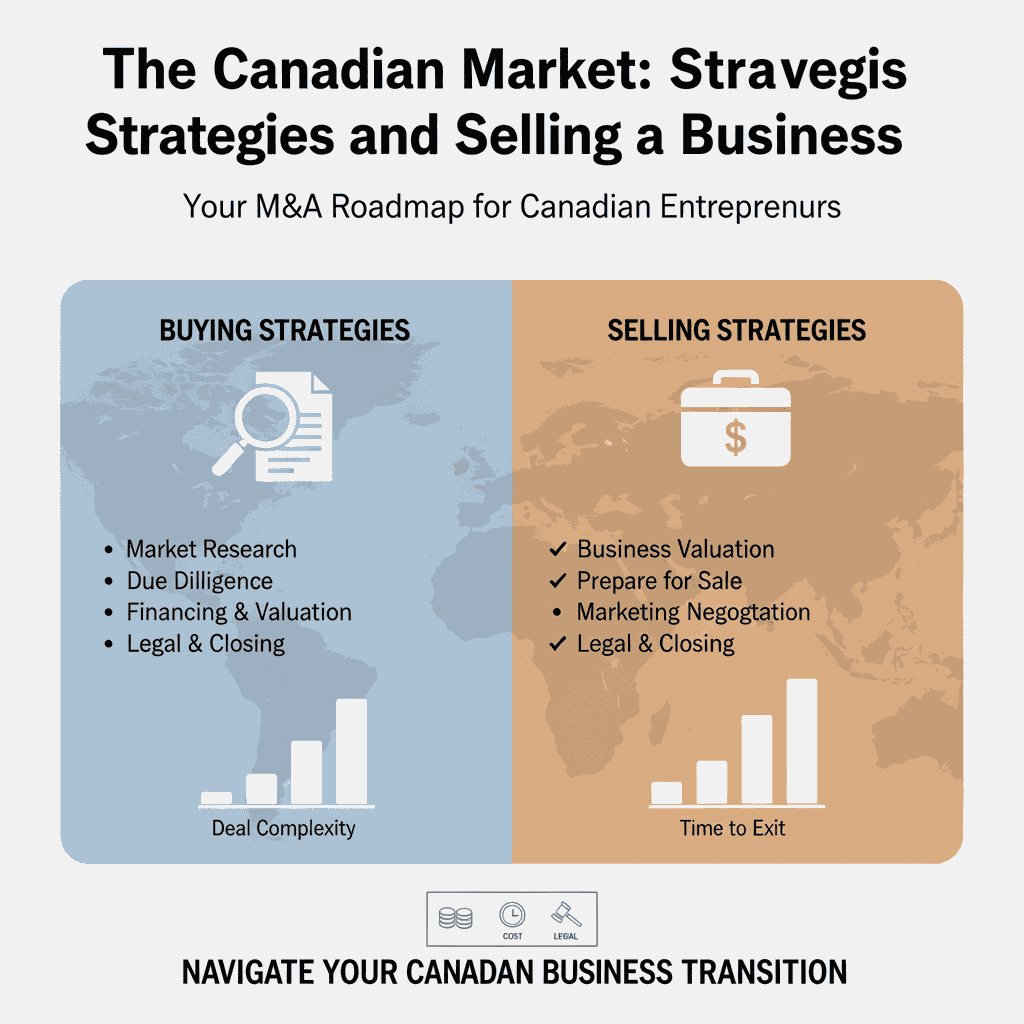
Buying or selling a business in the Canadian market requires careful planning and local expertise. Canada’s stable, advanced economy offers many opportunities for mergers and acquisitions, but it also has unique regulations, taxes and cultural expectations. This guide outlines key strategies for entrepreneurs, investors and advisors navigating business transactions in Canada. It covers market trends, due diligence, valuation, financing and legal steps – all aimed at ensuring a smooth, high-value deal. For example, as BDC observes, “Canada is undergoing a major shift in business ownership as the baby boomer generation moves to retire… we are in a ‘buyer’s market’”. Understanding these Canadian-specific trends and expectations (such as the emphasis on innovation, quality and sustainability) is crucial for success.
“Canadian buyers expect reasonable payment terms, sophisticated or cutting-edge technologies, on-time delivery, and competitive pricing and quality.”
Key Features of the Canadian Market
- Stable, export-oriented economy. Canada’s strong institutions and trade agreements (USMCA, CPTPP, etc.) make it an attractive place to do business. Major sectors include technology, natural resources and advanced manufacturing.
- Demographics favor buyers. A large cohort of retiring owners means many businesses are coming to market. This “buyer’s market” gives buyers more choices but also more competition.
- Sophisticated buyers and values. Canadian decision-makers expect quality, reliability and service. Emphasizing sustainability and local content can win favor. (Note: Quebec’s language laws mean materials often need both English and French versions.)
- Regulatory environment. Most business practices resemble those in the US, but certain rules apply (for example, Investment Canada Act approval may be needed for large foreign takeovers, and HST/GST elections affect sales tax on business assets). Legal compliance and transparency are non-negotiable.
Understanding these characteristics helps set realistic expectations. For instance, building a clean financial track record, protecting intellectual property, and showcasing repeatable processes can make a sale more attractive to Canadian buyers.
Preparing to Buy a Business in Canada
Acquiring an existing company can fast-track growth, but thorough preparation is essential. Key buyer strategies include:
- Set clear objectives. Define why you want the acquisition (market share, technology, talent, etc.) and what success looks like. Determine upfront which parts of the business (employees, products, processes) you’ll integrate or change.
- Due diligence. This is the backbone of any acquisition. Rigorously review the target’s financial statements, tax returns, contracts, customer data and legal issues. As BDC notes, “investing in a proper due diligence process should ensure a fair price”. A professional accountant or advisor can help uncover hidden liabilities (e.g. pending lawsuits, inaccurate books) before you commit.
- Valuation and pricing. Understand how the business is valued. Canadian deals often use EBITDA (earnings before interest, taxes, depreciation and amortization) multiples or asset values. Get a formal valuation if possible, and be ready to negotiate based on realistic numbers. Remember that goodwill and intangibles (brand reputation, technology) can carry significant value.
- Financing strategy. Explore a mix of funding sources. Options include bank loans, vendor financing (the seller provides a loan), mezzanine financing, or bringing in equity partners. BDC and private lenders offer business purchase loans designed for acquisitions. In many Canadian deals, the seller may agree to a partial payment arrangement to make the sale possible. Evaluate cash flow projections to ensure the business can service any new debt.
- Integration planning. Before closing, prepare a post-acquisition integration plan. Identify which systems, staff and processes must merge, and who will manage that process. A formal plan prevents culture clashes and disruption. (Pushing major changes too quickly can harm employee morale, as BDC warns that “rapid change following an acquisition can be met with resistance”.)
Checklist for Buyers:
- Review historical financials and tax filings.
- Verify legal standing (e.g. no hidden debts or liens).
- Assess customer base and market position (is the product/service unique?).
- Plan management and staff transitions.
- Secure financing commitments before finalizing the deal.
By doing homework early and involving the right advisors (lawyer, accountant, banker), buyers reduce risk and position themselves to negotiate effectively.
Preparing to Sell a Business in Canada
Selling requires a different focus: maximizing value and ensuring a smooth transition. Key seller strategies include:
- Plan ahead. Begin preparing for a sale well in advance – ideally years before. According to BDC, “many people wait too long before starting to plan the sale… they underestimate how long it takes to prepare a business”. Early planning allows you to boost profitability, diversify the customer base, and address any weaknesses.
- Maximize business value. Buyers pay more for strong profits and reliable cash flow. Improve your bottom line by tightening operations and proving consistent earnings. Develop a diversified client list (reducing risk if one client leaves). Implement systems and processes so the business can run without the owner. These steps increase your multiples on sale. (Remember: “the biggest driver of business value is profitability and your ability to prove it”.)
- Organize documentation. Have detailed, up-to-date records ready. Any potential buyer will conduct due diligence, so prepare financial statements (ideally audited), tax filings, contracts, customer and supplier information, employee records, and an asset list. Creating a confidential information memorandum (CIM) can summarize these for buyers. Consider a secure virtual data room for sharing documents with serious buyers. Well-organized records signal professionalism and build trust.
- Emotional discipline. Selling a business can be emotional. Stay objective and “keep a cool head”. Focus on financial and strategic goals rather than attachment to the company. This is especially important if it’s a family business; set clear roles so personal feelings don’t derail the deal.
- Engage advisors early. Don’t go it alone. Assemble a team (accountant, lawyer, broker/consultant) experienced in Canadian business sales. They can advise on tax strategies, deal structuring, and regulatory filings. For example, legal counsel can help decide between an asset sale or share sale (which has different tax consequences) and prepare the sales agreement.
“Many people wait too long before starting to plan the sale… they underestimate how long it takes to prepare a business for sale.”
Common Pitfalls to Avoid:
- Don’t fixate only on price. Choosing the right buyer matters more than squeezing an extra dollar. An insider (e.g. family or management) might offer less cash but ensure continuity. An outside buyer may pay more upfront but could require more complex handoffs. Decide what matters: cash at closing, legacy, speed, etc.
- Don’t be irreplaceable. If your business depends on you personally, buyers will discount it. Cross-train employees and document key processes. A company that can run smoothly without the owner is far more valuable.
- Don’t rush. A well-prepared sale can take 6–12 months (sometimes longer for large deals). Rushing negotiations or due diligence often leads to lower prices or collapsed transactions. Remain patient and cooperative with the buyer’s timetable, especially if they need to secure financing or regulatory approval.
- Don’t control the buyer’s lenders. Let interested financial partners (banks or investors) directly communicate with you. Resist “ghosting” them. Cooperating in good faith will help the buyer secure funds and close the sale.
- Don’t do it alone. Seek guidance from professionals. BDC recommends hiring succession or M&A advisors to “help plan your transition.” External experts can often highlight value drivers you might overlook.
Being proactive and transparent can significantly increase the sale price and reduce last-minute complications.
Deal Structuring and Financing
Structuring the deal correctly is crucial for both parties. Important points include:
- Structure (assets vs shares). In Canada, you can sell assets (equipment, IP, goodwill) or shares (selling ownership). Each has tax implications: asset sales often mean GST/HST elections (certain transactions may be tax-free if conditions met), while share sales may allow the seller to use lifetime capital gains exemptions. Consult a tax advisor on which method is more advantageous.
- Purchase price and payment terms. Beyond a lump-sum payment, deals often include earn-outs (additional payments if the business hits targets), retention bonuses or seller financing. These can bridge valuation gaps. For example, vendor financing (the seller lending funds to the buyer) is common: it provides “patient capital” and motivates the seller to support the transition.
- Allocation of purchase price. Agree on how the price breaks down (e.g. $X for equipment, $Y for goodwill). This affects taxes and depreciation for the buyer and taxes for the seller.
- Legal agreements. Work with lawyers to draft a clear purchase agreement. It should cover warranties (seller’s assurances about the business), indemnities (handling of any undisclosed liabilities), non-compete clauses, and closing conditions (e.g. financing secured). In regulated industries (fintech, cannabis, etc.), include clauses about regulatory consents or license transfers.
Financing sources: Banks (like RBC, BMO, TD) offer commercial loans or lines of credit for acquisitions. The Business Development Bank of Canada (BDC) offers a Business Purchase or Transfer Loan specifically for buying companies. Also consider government-backed programs or venture capital for larger deals. Sometimes sellers or third-party investors take equity stakes to fund the purchase. In any case, work with lenders familiar with acquisitions to ensure the structure is lender-friendly.
Regulatory and Legal Considerations
Canada’s regulatory landscape can affect your transaction:
- GST/HST on transfers. By default, selling business assets can trigger GST/HST. However, Canadian tax law allows a joint election (subsection 167(1) of the Excise Tax Act) where the sale of a “going concern” can be tax-free if conditions are met. Both buyer and seller must be registered and file the election properly. Consult a tax expert to use this provision correctly.
- Industry regulations. If the business is regulated (e.g. financial services, telecom, health care), you’ll need regulator approval. For instance, transferring a money services business (MSB) registration or Electronic Money Institution (EMI) license requires filings with authorities (FINTRAC in Canada, or FCA in the UK, etc.). 7BaaS helps navigate licensed fintech transfers (see their Buy/Sell Licensed Companies service). Complying with anti-money laundering (AML) rules and know-your-customer (KYC) checks is also essential.
- Securities laws. If you sell shares of a corporation, securities regulators in the province may require disclosure or filings. There may also be restrictions if foreign investors are involved (Investment Canada Act reviews thresholds for foreign acquisitions).
- Employment and Contracts. Review employment laws: severance or transfer of employees might be required. Check key supplier or lease contracts for “change of control” clauses that could terminate agreements. Ensuring third parties consent to the sale can avoid surprises.
- Confidentiality and Non-Compete. Maintain confidentiality during negotiations. A mutual NDA is standard. Sellers often require buyers to sign a non-compete to prevent them from poaching customers or starting a rival business. These agreements must be reasonable in scope and duration to be enforceable under Canadian law.
By aligning the deal structure with legal and tax rules, and using expert counsel, both buyers and sellers protect value and avoid costly delays.
Conclusion and Call to Action
Navigating the Canadian market for buying or selling a business demands careful strategy and local insight. Thorough preparation on both sides, diligent due diligence for buyers and value-maximizing planning for sellers, makes the transaction smoother and more profitable. Leveraging professional advice, from financing experts to corporate lawyers, is key to addressing the complex legal and tax issues involved.
Whether you’re a startup CEO looking to acquire an established firm, or an owner ready to exit your Canadian venture, 7BaaS can help. Our Buy/Sell Licensed Companies service provides end-to-end support (due diligence, valuation, regulatory filings and transition) to ensure compliant, high-value deals. We also publish tailored guides – for example, on selling licensed fintech businesses and acquiring MSB/EMI licenses – to empower entrepreneurs. Contact 7BaaS today for a consultation and let our experts guide you through the process.
FAQs
Q: What steps are involved in buying a business in Canada?
A: Key steps include defining your acquisition criteria, conducting thorough due diligence, arranging financing, negotiating a fair price (often based on EBITDA and assets), and planning the integration. Due diligence is especially crucial in Canada; it should cover financials, legal issues, customer contracts, and operations. It’s also wise to consult a lawyer and accountant early, to structure the deal (asset vs share sale) and handle tax issues.
Q: How can I finance the purchase of a Canadian business?
A: Financing options include bank loans (many Canadian banks offer acquisition financing), government-backed loans (the Business Development Bank of Canada’s Business Purchase or Transfer Loan is one example), seller/vendor financing, equity investors, or a mix of these. BDC recommends using a combination of debt and equity to spread risk. The assets of the target business (equipment, receivables) can often be collateral for loans. Sometimes the seller will finance part of the sale price, which aligns their interests with a successful transfer.
Q: How should I prepare my business for sale in Canada?
A: Start preparations early. Improve profitability and diversify clients to increase value. Organize and update all records: financial statements, tax filings, contracts, employee agreements, asset inventories, and any permits/licenses. Develop a formal process for handing over operations (such as an employee transition plan). Work with advisors (brokers, accountants, lawyers) to fix any legal or tax issues beforehand. Also, draft a comprehensive Information Memorandum to present to potential buyers. Proper preparation can prevent last-minute deal breakers and justify a higher sale price.
Q: Are there tax implications when selling a business in Canada?
A: Yes. Sales of business assets can trigger GST/HST unless both parties elect a “sale of a going concern” under Canadian tax law. Capital gains tax applies on profits from the sale of shares or assets (individuals may use the Lifetime Capital Gains Exemption in qualifying share sales). The structure (asset vs share sale) greatly affects taxes: asset sales often have more immediate tax cost for the buyer (depreciation resets) but may allow the seller to allocate purchase price among asset classes. Always involve a tax professional to minimize liabilities for both buyer and seller.
Q: How long does it take to buy or sell a business in Canada?
A: The timeline varies by deal size and complexity, but typically a sale or acquisition takes 6–12 months. Planning and preparation should ideally begin years in advance. Once you have a buyer or a target, due diligence and negotiation can last several months. Legal and regulatory approvals (especially for regulated industries or foreign investments) can add time. As BDC warns, “the sale of a business can be a complicated endeavor… things such as deal structure… add to the timeline”. Patience and realistic scheduling are important for success.
Q: What is due diligence and why is it important?
A: Due diligence is a detailed investigation of the target business by the buyer (or vice versa). It covers all areas: financial health, legal compliance, customer contracts, intellectual property, and more. In Canada, due diligence is vital because it uncovers risks (bad debts, legal claims, regulatory issues) that the paperwork alone won’t show. BDC emphasizes that without proper due diligence, buyers “could be cooking the books” and might end up overpaying. Thorough due diligence ensures both parties negotiate a fair deal based on reality.
Q: Should I hire a broker or advisor to sell my business?
A: Yes. Business transfers involve complex negotiations, confidential marketing and legal processes. A professional M&A advisor or broker can help value your business, find qualified buyers, and manage negotiations. Similarly, lawyers and accountants ensure contracts are solid and taxes optimized. According to BDC, even large companies engage specialists for successions and M&A. Hiring experts often leads to a higher sale price and a smoother transition than going it alone.